

Skip to content

Feed

eight two eightAdmin

Posted in FOR YOUR SOUL

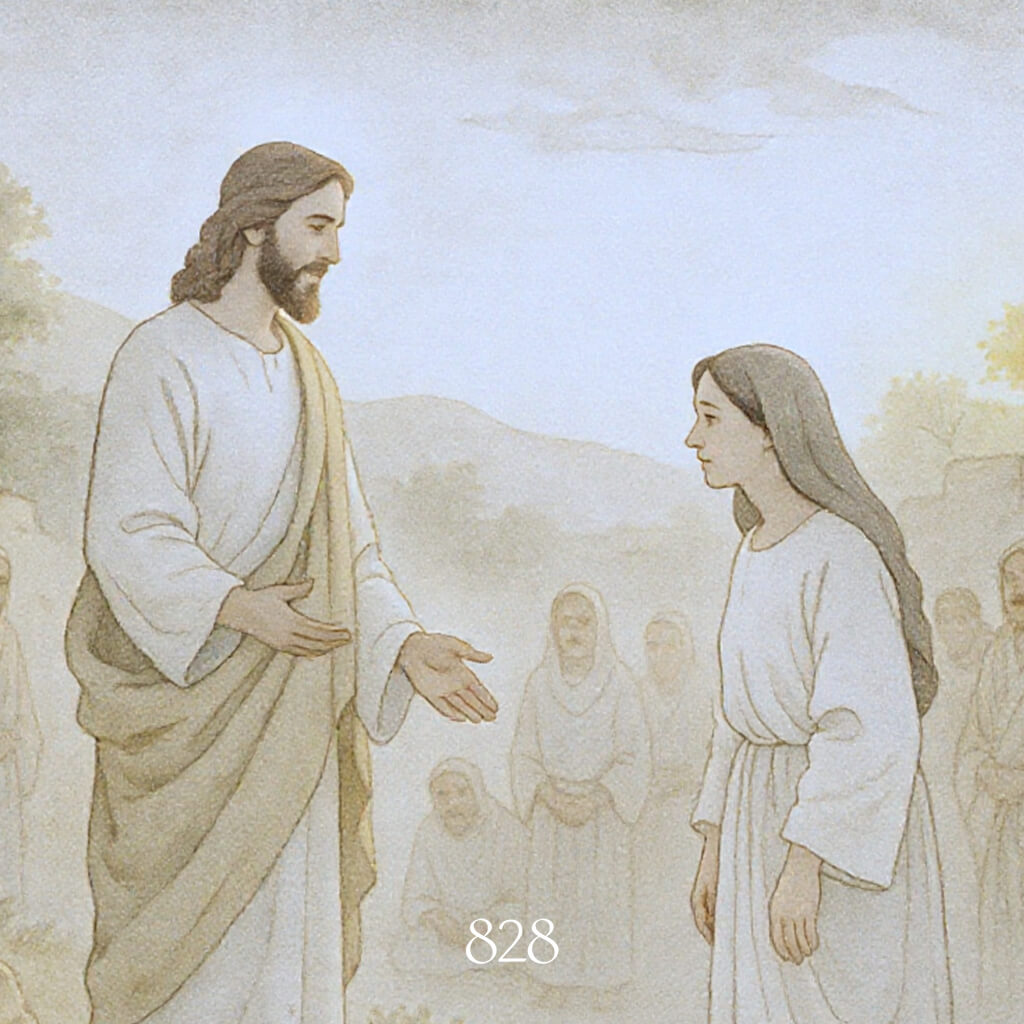
Isaiah 61:7 verse card

A Message Has Arrived for You

These are God's promises for you today:

"Instead of your shame you will have a double portion"

"Instead of dishonor you will rejoice in your portion"

"Everlasting joy will be yours"

Have you ever carried shame or dishonor? Sh...

Deep Dive

The Story Behind The Verse: The Promise of Restoration
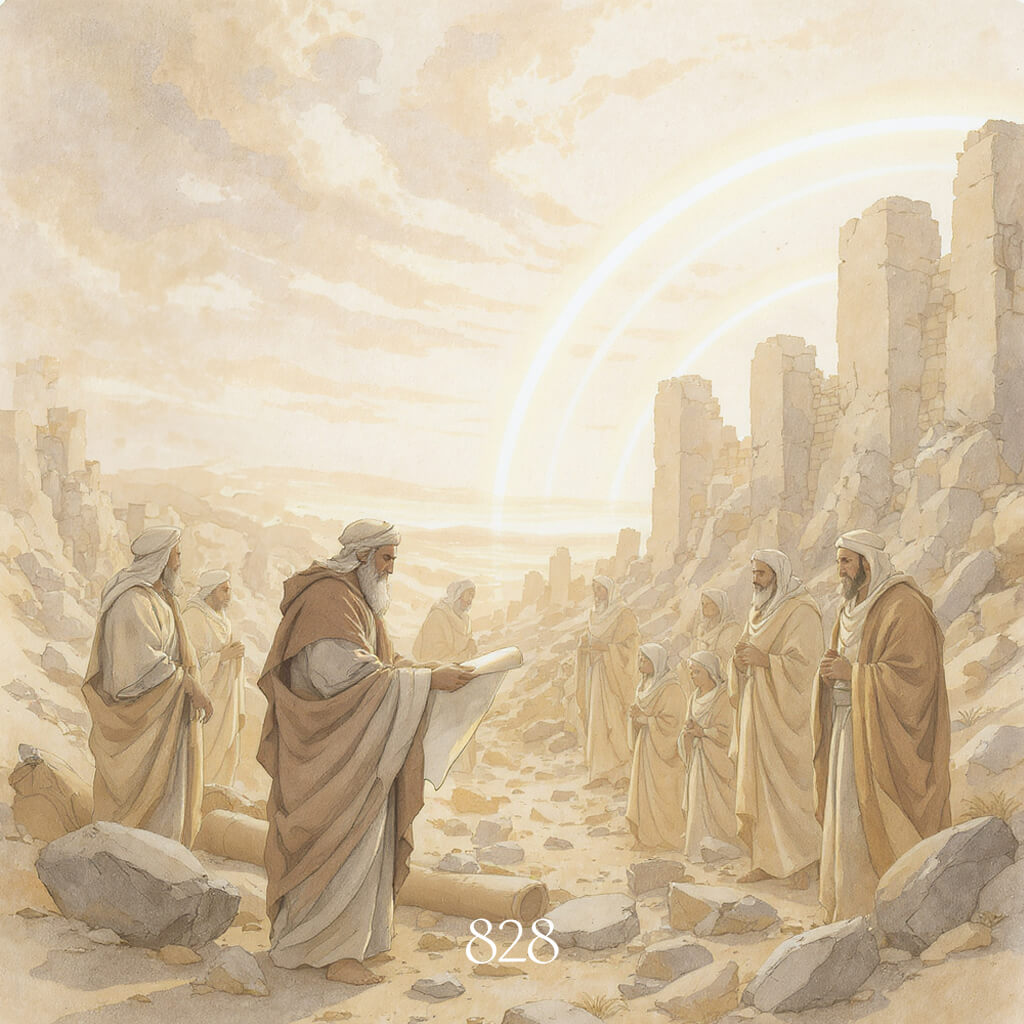
Isaiah 61:7 - Story Behind the Verse

Isaiah 61 is part of a prophecy spoken around 700 BC to a people who would face unimaginable shame and loss. Isaiah was speaking about the Babylonian exile that was coming, the destruction of Jerusalem, and the humiliation of God's people being taken away as captives. To the Israelites who were soon to experience exile, God gave a promise of restoration. But this prophecy carries has deeper significance. Like many prophecies in the Old Testament, Isaiah 61 had a near-term fulfillment for the Israelites of that time and a far-term fulfillment through the Messiah who was yet to come.

Isaiah 61 opens with the declaration of the Messiah's mission: to bring good news to the poor, freedom to the captives, and comfort to those who mourn (Isaiah 61:1-2). Hundreds of years after the prophet Isaiah proclaimed these words, Jesus Himself read these words in the synagogue at Nazareth and declared, "Today this scripture is fulfilled in your hearing" (Luke 4:21). Jesus came to bring the restoration God promised through Isaiah. Through His life, death, and resurrection, He makes this promise of restoration available to all who come to Him.

To fully understand this promise, we need to look more closely at its words. You may notice the verse shifts between "you" and "they." This reflects the Hebrew original, where the promise is both personal to you and for God's people as a whole. Through this promise, God assures those who have known shame that they will receive a double portion. In Hebrew culture (as mentioned in Deuteronomy 21:17), the firstborn son received a double portion of the inheritance. It was a sign of honor and special standing. When God promises a double portion in place of shame, He is not just making up for what was lost. He is lifting up those who had been dishonored and giving them the honor of the firstborn.

This pattern of double restoration appears throughout Scripture. After losing everything, Job received twice as much as he had before (Job 42:10). After years of imprisonment and disgrace, Joseph was elevated to the second highest position in Egypt (Genesis 41). This is the pattern we see in Scripture: when God restores, He does so with great abundance.

The same God who gave the Israelites a double portion of restoration speaks this promise over your life today. Your shame and loss are not your final chapter. God is giving you joy that will last forever.

What It Means

"Instead of your shame" (תַּחַת בׇּשְׁתְּכֶם / tachat boshtekhem)

Tachat means instead of or in place of, describing a complete replacement. Boshet means shame, humiliation, or disgrace. God is not just comforting you in your shame. He is taking the shame away and giving you something else in its place.

"A double portion" (מִשְׁנֶה / mishneh)

Mishneh means double or twofold. This is the same double portion given to the firstborn son, who received twice what other sons received (Deuteronomy 21:17). God is giving you the firstborn's blessing. What was taken is not just restored. It is doubled.

"Instead of dishonor you will rejoice" (וּכְלִמָּה יָרֹנּוּ / ukhlimmah yaronnu)

Klimmah means dishonor, reproach, or contempt. Ranan means to shout for joy. Where there was scorn and mockery, there will be celebration.

"Everlasting joy" (שִׂמְחַת עוֹלָם / simchat olam)

Simchah means joy or gladness. Olam means forever or for all eternity. The joy God gives is not temporary relief that fades when circumstances change. It is permanent and lasting. This is the kind of joy that endures beyond any season.

Claim This Promise

I declare that the words of Isaiah 61:7 are true in my life.

  • • Where I have experienced shame, God gives me a double portion.
  • • Where I have faced dishonor, God gives me a portion to rejoice in.
  • • The joy God gives me is everlasting.
Today's Prayer

God,

Thank You for promising restoration where there has been shame and dishonor.

At times, I believed that what was taken from me would not be restored. I also felt that shame and dishonor would define me.

Today I receive Your promise. You do not just restore what was taken. You give a double portion to rejoice in.

I trust that my present season is not my final chapter. You are the God who gives double, and Your restoration is already at work.

In Jesus' name I pray, Amen.

Share This Message

Do you know someone who has experienced shame or loss?

Share this with them and say, "God does not just restore what was taken. He gives a double portion. The joy He brings is everlasting."

Your simple act of sharing could remind them that their shame is not the final chapter and that God's restoration is already on its way.
See more: Isaiah 61:7
eight two eightAdmin

Posted in FOR YOUR SOUL

Matthew 5:3-4 verse card

A Message Has Arrived for You

These are God's promises for you today:

"Blessed are the poor in spirit"

"Theirs is the Kingdom of Heaven"

"Blessed are those who mourn"

"They shall be comforted"

Have you ever felt like you were not enough?

The world tells us ...

Deep Dive

The Story Behind The Verse: When Jesus Redefined Blessing
Matthew 5:3-4 - Story Behind the Verse

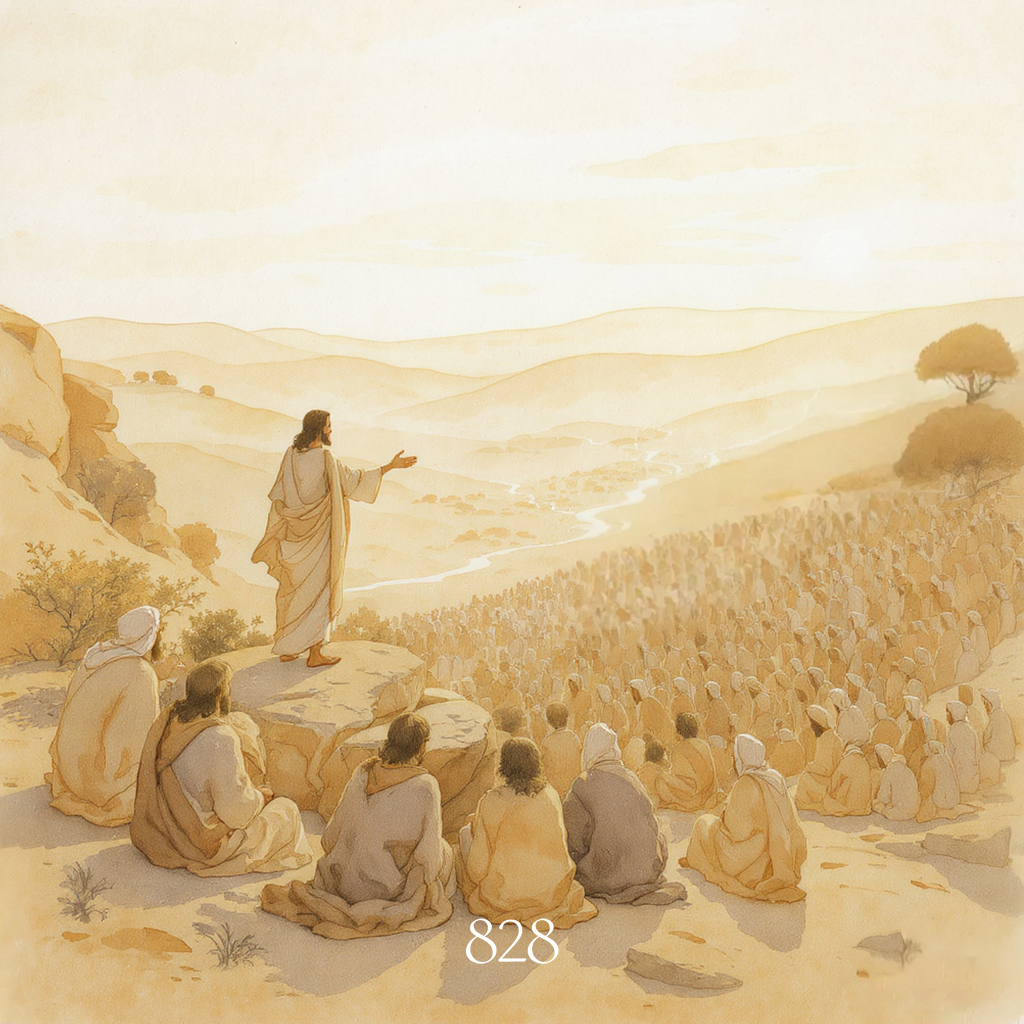
This verse comes from Jesus' Sermon on the Mount, spoken to a crowd on a hillside overlooking the Sea of Galilee around AD 28. The people who gathered were not the wealthy or the religious elite. They were fishermen, laborers, the sick, and the outcast. These people lived in a society where health, prosperity, and respect were considered to be blessings. In contrast, poverty, sickness, and struggles were looked down upon.

The religious leaders of the day reinforced this. Wealth was seen as a sign of God's favor. Poverty and suffering were seen as evidence of sin. The people in that crowd had come to believe that God's blessing was not for them.

Then Jesus spoke words that overturned everything they had been taught. "Blessed are the poor in spirit, for theirs is the Kingdom of Heaven. Blessed are those who mourn, for they shall be comforted." The very people who had been told they were outside of God's favor were now being told they were blessed.

Jesus was not saying that the state of poverty or sorrow is good. He was revealing how God's Kingdom works. Those who need God and earnestly seek Him are the ones who receive from Him. Those who mourn over what is broken are the ones God draws near to comfort.

The people on that hillside heard something no one had ever told them: their emptiness was not a disqualification. It was the very thing that made them ready to receive what God wanted to give. The same is true for you today. Your emptiness, your sorrow, and your sense of need are not a disqualification. They are the very things that make you ready to receive what God wants to give you.

What It Means

"Blessed" (μακάριοι / makarioi)

Makarioi describes a deep, settled state of being that is not dependent on circumstances. It is a blessedness that cannot be taken away because it rests in who God is. Jesus takes this word and gives it to the poor and the mourning. He is declaring that those who come to God in their need are in a state of divine favor right now, not because of what they have but because of who God is to them.

"Poor in spirit" (οἱ πτωχοὶ τῷ πνεύματι / hoi ptōchoi tō pneumati)

Ptōchos describes complete destitution. It refers to someone who has nothing of their own and relies on others for survival. "Poor in spirit" is the same posture before God. It is recognizing that we have nothing to offer Him on our own and that we are fully dependent on His grace. Jesus says this state is blessed because those who come with empty hands are the ones who receive from God.

"Theirs is the Kingdom of Heaven" (αὐτῶν ἐστιν ἡ βασιλεία τῶν οὐρανῶν / autōn estin hē basileia tōn ouranōn)

Estin is present tense. Not "will be theirs" but "is theirs." The Kingdom of Heaven belongs to the poor in spirit right now. This is not a future reward for enduring hardship. It already belongs to those who come to God knowing they need Him.

"Those who mourn" (οἱ πενθοῦντες / hoi penthountes)

Pentheō means to grieve deeply, the kind of grief felt when losing someone you love. Jesus is speaking of those who feel the weight of what is broken in their lives and in the world around them. This is not despair. This is bringing honest grief before God.

"They shall be comforted" (αὐτοὶ παρακληθήσονται / autoi paraklēthēsontai)

Paraklēthēsontai is in the passive voice, meaning comfort will be given to them by someone else. That someone is God Himself. The Greek word comes from parakaleō, which means to come alongside, to console, to draw near. Those who mourn will receive comfort directly from God as He draws near to them.

Claim This Promise

I declare that the words of Matthew 5:3-4 are true in my life.

  • • I am blessed when I come to God knowing I need Him.
  • • When I am poor in spirit, the Kingdom of Heaven is mine.
  • • When I am grieving, God comforts me.
Today's Prayer

God,

Thank You for calling the poor in spirit blessed and calling those who mourn blessed.

I have at times tried to come before You with something to offer, as if Your blessing depended on what I could bring. I have also hidden my grief, thinking that mourning was a sign of weakness.

Today I come to You with empty hands, and I rely on Your grace. I receive Your promise that I belong to Your Kingdom.

I bring my grief to You as well. I lay before You the weight of what is broken. Thank You that You do not turn away from those who mourn. You draw near and comfort me.

Help me to see my need as the place where Your grace enters. May I bring my grief to You instead of carrying it alone.

Thank You for giving me a place in Your Kingdom. Thank you for Your comfort that comes not from the world but from You.

In Jesus' name I pray, Amen.

Share This Message

Do you know someone who is poor in spirit? Or someone who is grieving and wondering if God sees them?

Share this with them and say, "Jesus says you are blessed. Come to God as you are and receive His blessing."

Your simple act of sharing could remind them that their need for God is the place where His grace enters.

See more: Matthew 5:3-4
eight two eightAdmin

Posted in FOR YOUR SOUL

Mark 1:40-41 verse card

A Message Has Arrived for You

These are God's promises for you today:

"I see you, and my heart is moved with compassion."

"I reach out my hand to you."

"I am willing. Be made clean."

Have you ever wondered if God is willing to help you?

Many of us do not d...

Deep Dive

The Story Behind The Verse: The Outcast Who Came to Jesus
Mark 1:40-41 - Story Behind the Verse

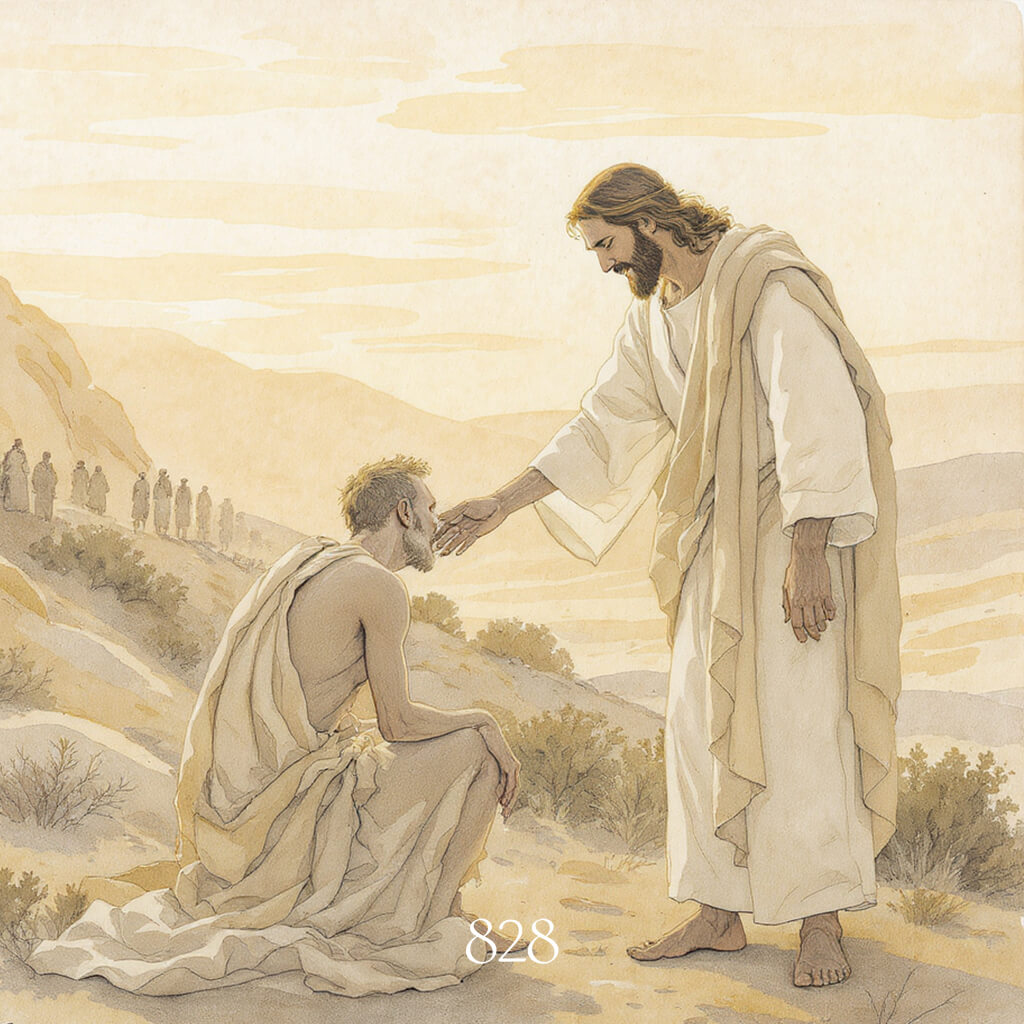
Under Jewish law, a person with leprosy was required to live outside the community. They wore torn clothes, left their hair loose, covered their face, and had to cry "Unclean" whenever anyone approached. They could not work, worship in the synagogue, or participate in community life. No one would come near them. They were isolated from everything and everyone.

This man had been living in that reality. When he heard about Jesus, he pushed through a crowd and fell at Jesus' feet. He said, "If you want to, you can make me clean." He was certain about Jesus' power. What he was unsure of was whether Jesus would want to help someone in his condition. This is a question many of us carry: "God is able to, but will He?"

Jesus responded first with action. He stretched out His hand and touched the leper. Under the law, touching a leper made you unclean. Yet Jesus touched him anyway. Then Jesus spoke, "I want to. Be made clean." Immediately the leprosy left him. He was not only healed physically. He was made clean, which meant he could return to his family, his community, and his place of worship. With Jesus' touch, what had defined him as an outcast for years was gone.

Jesus who reached out and touched the leper is reaching out to you today. Whatever you carry, bring it to Him. He is willing to help, heal, and restore you.

What It Means

"If you want to, you can make me clean" (ἐὰν θέλῃς δύνασαί με καθαρίσαι / ean thelēs dunasai me katharisai)

The leper does not question Jesus' ability. He knows that Jesus can heal him. What he questions is whether Jesus is willing to do so. While dunasai speaks of power or ability, the word thelēs speaks of desire or willingness. His request is not about possibility but about whether Jesus is willing to act on his behalf.

"Being moved with compassion" (σπλαγχνισθείς / splanchnistheis)

Splanchnistheis comes from splanchna, meaning the inner organs. It describes deep compassion felt physically. It is not a distant concern or sympathy. When Jesus saw the leper, he felt the man's suffering as His own. This is who Jesus is toward those who come to Him in need.

"He stretched out his hand and touched him" (ἐκτείνας τὴν χεῖρα ἥψατο αὐτοῦ / ekteinas tēn cheira hēpsato autou)

Ekteinas means to stretch out or to reach toward. Hēpsato means to touch or to make physical contact. The act of reaching out and touching the leper is as significant as the healing itself. Under the Levitical law, touching a leper made a person unclean. Yet Jesus does not heal from a distance. He crosses the social and relational boundaries that kept the man isolated and meets him where he is. Before Jesus heals him of his leprosy, the separation is broken.

"I want to. Be made clean." (θέλω καθαρίσθητι / thelō katharisthēti)

Jesus answers the leper's question, "I want to." His willingness is direct and assured. The command katharisthēti calls for immediate and complete cleansing. This is not a process that unfolds over time but a decisive act. Jesus does not only heal the disease. He fully restores the person.

Claim This Promise

I declare that the words of Mark 1:40-41 are true in my life.

  • • Jesus wants to help me.
  • • Jesus reaches out to heal and restore me.
  • • His touch removes what has defined me and sets me free.
  • • I am clean and accepted by Him.
Today's Prayer

Jesus,

Thank You that You are willing.

I have at times wondered if You would want to help someone like me. I have believed in Your power but doubted Your willingness to use it for me.

Today I hear Your answer: "I want to. Be made clean."

Thank You that You do not turn away from what I carry. You reach toward it. Just as You stretched out Your hand and touched the leper before You healed him, You reach into my life with the same compassion.

I come to You as I am. I bring what I have been hiding and what I have been carrying alone. I trust that You are not reluctant but willing. I trust that You will help me. I trust that You will bring complete healing and restoration.

Make me clean. Restore what has been lost. Help me to walk freely, knowing that You have accepted me fully.

In Your name I pray, Amen.

Share This Message

Do you know someone who doubts whether God is willing to help them?

Share this with them and say, "Jesus says, 'I want to. Be made clean.'"

Your simple act of sharing could remind them that God wants to help them.

See more: Mark 1:40-41
eight two eightAdmin

Posted in FOR YOUR SOUL


Isaiah 38:5 verse card

A Message Has Arrived for You

These are God's promises for you today:

"I have heard your prayer"

"I have seen your tears"

"Call on me in the day of trouble; I will deliver you"

Have you ever wondered if God hears your prayers and sees your tears?

Here is ...

Deep Dive

The Story Behind The Verse: The God Who Hears and Sees
Isaiah 38:5 - Story Behind the Verse

King Hezekiah was one of the faithful kings in the history of Judah. He trusted the Lord with his whole heart and led the people of Judah back to true worship of God. When the Assyrian army of 185,000 soldiers surrounded Jerusalem, he witnessed God deliver the city.

Then, after this great deliverance, Hezekiah became ill. The prophet Isaiah came to him with a message from God, "Set your house in order, for you will die, and not live" (Isaiah 38:1).

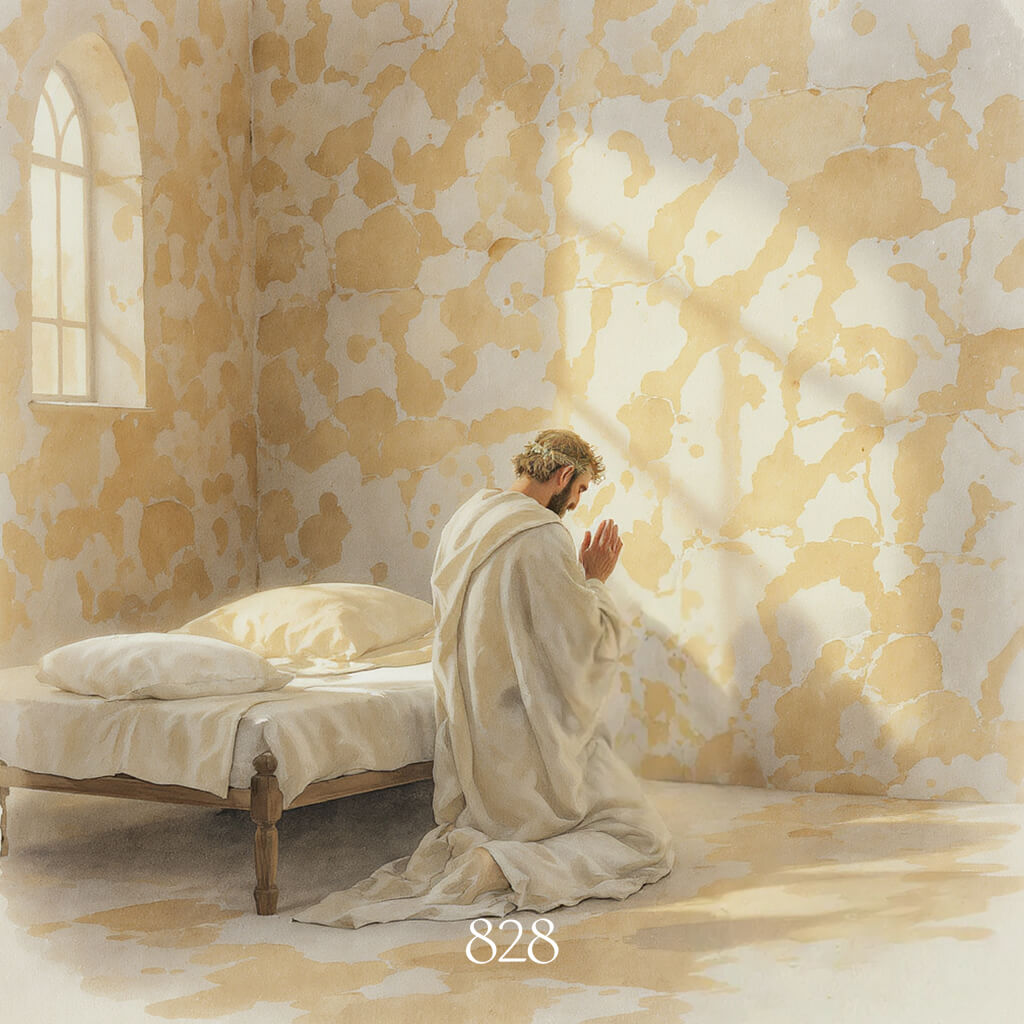
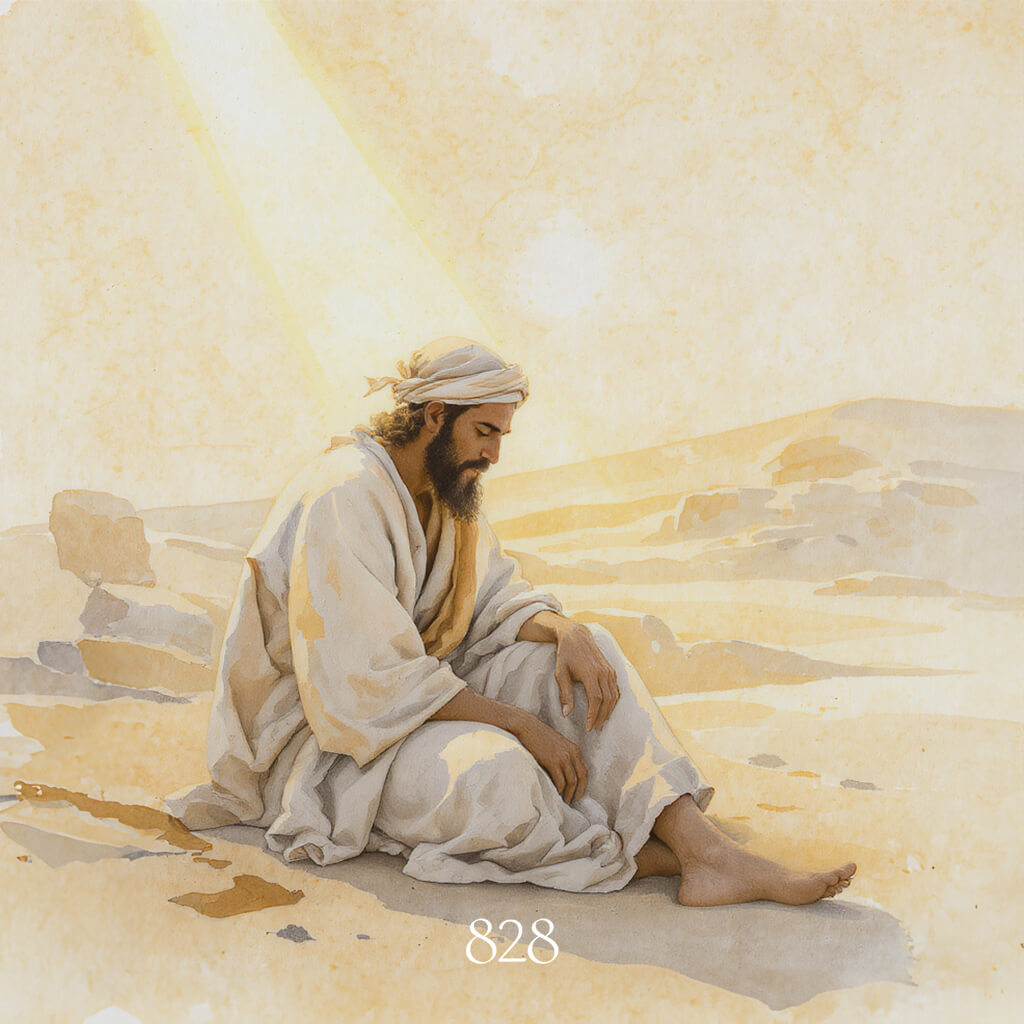
Hezekiah turned his face to the wall and prayed. He reminded God of how he had walked faithfully before Him, and he wept bitterly. His prayer was the earnest cry of a man pouring out his heart before God.

Before Isaiah had even crossed the middle courtyard of the palace, God spoke again. He told Isaiah to go back and deliver a new message, "I have heard your prayer. I have seen your tears. Behold, I will add fifteen years to your life." God responded to Hezekiah's prayer.

The same God who heard an earnest prayer and added fifteen years to Hezekiah's life is your God today. He hears your prayers. He sees your tears. He will respond in His timing and way.
What It Means

"I have heard your prayer" (שָׁמַעְתִּי אֶת־תְּפִלָּתֶךָ / shamati et-tefillatekha)

Shama means to hear in a way that leads to a response. When God says He has heard your prayer, He has truly received it and will respond in His way and timing.

"I have seen your tears" (רָאִיתִי אֶת־דִּמְעָתֶךָ / ra'iti et-dim'atekha)

Ra'ah means to see, to observe carefully, and to pay close attention. God does not just notice your tears but remembers them. Psalm 56:8 says God puts our tears in His bottle. Every tear matters to Him.

"Behold, I will add fifteen years" (הִנְנִי יוֹסֵף עַל־יָמֶיךָ חֲמֵשׁ עֶשְׂרֵה שָׁנָה / hineni yosef al-yamekha khamesh esreh shanah)

Hineni means "Behold, here I am." God is declaring that He is fully present and ready to act. Yosef means to add or to increase. God gave Hezekiah fifteen additional years of life.

Claim This Promise

I declare that the words of Isaiah 38:5 are true in my life.

  • • God hears my prayers.
  • • God sees my tears.
  • • God responds to those who earnestly seek Him.
Today's Prayer

God,

Today, I receive the words You spoke to Hezekiah, "I have heard your prayer. I have seen your tears." Thank You for seeing me and hearing me with intent to respond.

Remind me that You are the God who responded to Hezekiah and extended his life. When my prayers have not yet been answered, may I keep coming to You in prayer until You answer.

Give me wisdom to understand Your answer to my prayers. Sometimes You answer by changing my circumstances or my relationships. Sometimes You answer by renewing my mind and heart. Sometimes, You do not give a clear answer, and that itself is an answer.

You keep a record of my prayers, and I trust that You will respond in Your good timing and way.
In Jesus' name I pray, Amen.

Share This Message

Do you know someone who wonders if God hears their prayers?

Share this with them and say, "God hears your prayers and knows what you are going through." Your simple act of sharing could remind them that they matter to God.

See more: Isaiah 38:5
eight two eightAdmin

Posted in FOR YOUR SOUL

Matthew 8:13 verse card

A Message Has Arrived for You

These is God's promise for you today:

"Let it be done for you as you have believed"

Have you ever needed something that was beyond your ability?

A Roman centurion faced this when his servant, who was dear to him, was dying....

Deep Dive

The Story Behind The Verse: The Centurion Who Understood Authority
Matthew 8:8-9, 13 - Story Behind the Verse

The centurion was a Roman officer of high standing, known for his love for the Jewish people and for building their synagogue (Luke 7:5). His servant, who was dear to him, had become paralyzed and was suffering terribly. Yet for all his authority and resources, he could do nothing for him.

He sent Jewish elders to Jesus, asking Him for help. Jesus responded immediately, "I will come and heal him" (Matthew 8:7). Jesus did not hesitate and was willing to enter a Gentile's home, which would have been unusual for a Jewish teacher at that time.

Then the centurion said something that made Jesus marvel. He said, "Lord, I am not worthy for you to come under my roof. Just say the word, and my servant will be healed." As a military commander, he understood how authority works. When an order is given, it is obeyed not because of the person delivering it but because of the authority of the one who issued it. If his commands carried that kind of authority because Rome's power was delegated through him, how much more would a word from Jesus carry authority as the son of God?

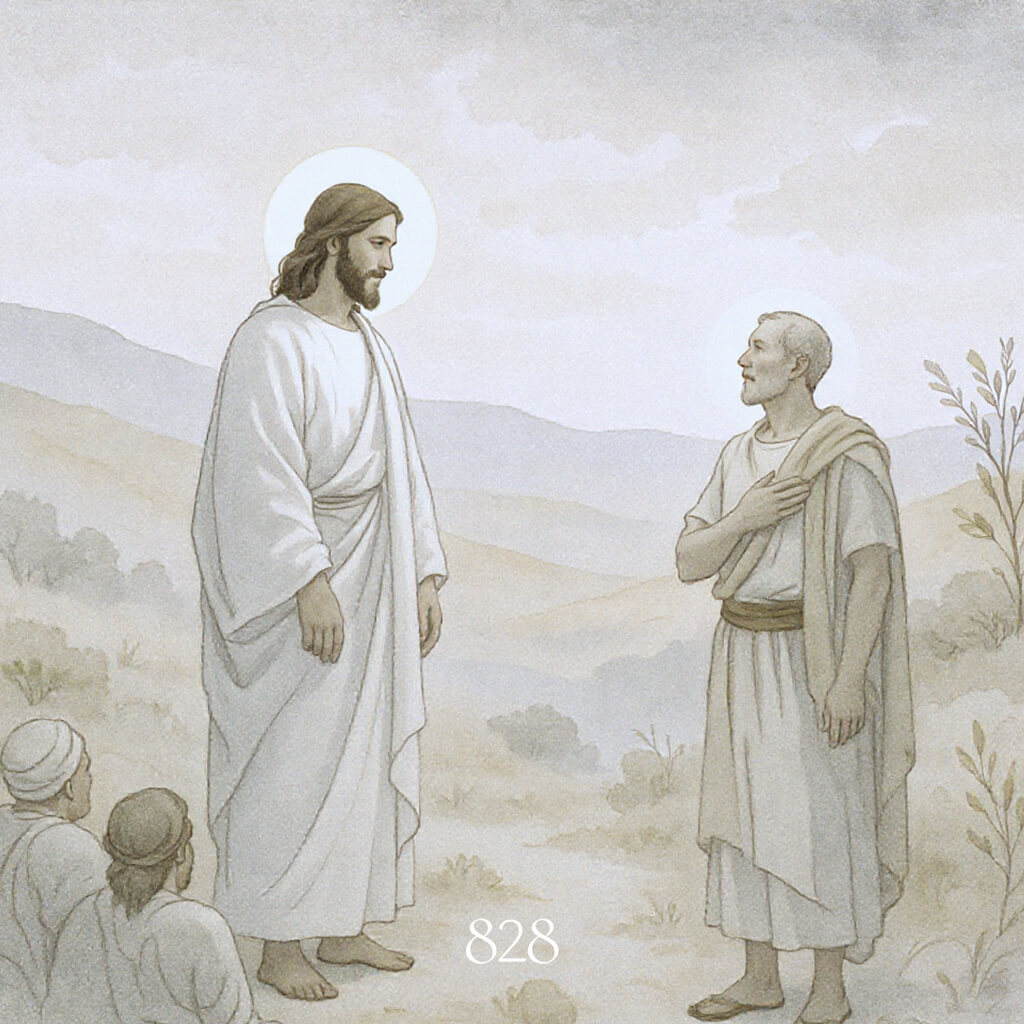
Jesus turned to those following Him and said, "I have not found such great faith, not even in Israel" (Matthew 8:10). The centurion understood that Jesus' word carried authority over all circumstances. Jesus said to him, "Go your way. Let it be done for you as you have believed." In that hour, the servant was healed. At the moment Jesus spoke, miles away, the servant was restored. The centurion's trust in the authority of Jesus' word was met with the full power of that word in action.
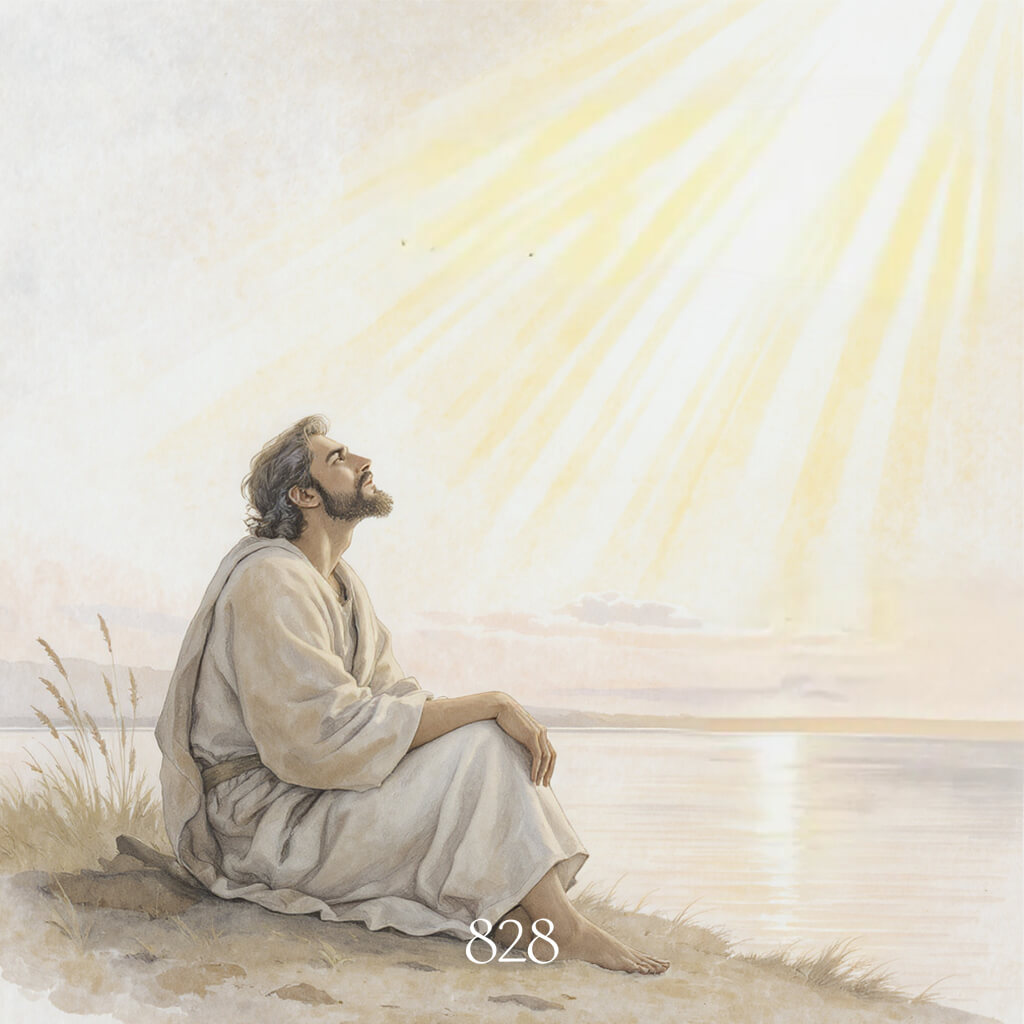
The same Jesus whose word healed the centurion's servant speaks over your life today. Whatever you are facing that is beyond your ability, bring it to Jesus. His word has the power to change your life.

What It Means

"Let it be done" (γενηθήτω / genēthētō)

Genēthētō means "let it be done" or "let it come to pass." When Jesus speaks these words, He is declaring what will take place. His word carries authority, and what He speaks comes into being.

"For you" (σοι / soi)

Soi means "to you" or "for you." This word makes the statement personal. Jesus is addressing one person in response to that person's faith.

"As you have believed" (ὡς ἐπίστευσας / hōs episteusas)

Episteusas means "you believed" or "you trusted," and hōs means "as" or "in accordance with." Jesus connects the outcome to the centurion's faith. The centurion trusted in the authority of Jesus' word, and the outcome follows that trust.

"His servant was healed in that hour" (ἐν τῇ ὥρᾳ ἐκείνῃ / en tē hōra ekeinē)

En tē hōra ekeinē means "at that very hour" or "at that exact moment." The healing happened at the moment Jesus spoke. It did not require Jesus' physical presence. His authority is not limited by distance or circumstance.

Claim This Promise

I declare that the words of Matthew 8:13 are true in my life.

  • • I will trust in the authority of Jesus' word.
  • • Jesus speaks over my situation.
  • • His word has the authority and power to bring change.
Today's Prayer

Jesus,

Thank You that Your word carries authority over every circumstance.

I have faced situations that were beyond my ability. I have tried to handle things on my own instead of bringing them to You.

Today I come to You as the centurion did. I bring before You what I cannot change on my own. Speak Your word over my life. I trust that Your words have the power to bring change. As I believe, let it be done accordingly.

Thank You that You respond to those who come to You in faith.

In Your name I pray, Amen.

Share This Message

Do you know someone facing something beyond their abilities?

Share this with them and say, "Bring it to Jesus. He sees your situation and has the power to change it." Your simple act of sharing could remind them to place their trust in the authority of Jesus' word.

See more: Matthew 8:13
eight two eightAdmin

Posted in FOR YOUR SOUL


Luke 8:50 verse card

A Message Has Arrived for You

These are God's promises for you today:

"Do not be afraid"

"Only believe"

"I am the resurrection and the life" (John 11:25)

Have you ever received news that left you feeling hopeless?

When the world says it is over, Jesus spea...

Deep Dive

The Story Behind The Verse: Do Not Be Afraid. Only Believe.
Luke 8:50 - Story Behind the Verse

Jairus was a synagogue leader, a man of standing and dignity in his community. When his twelve-year-old daughter, his only child, fell gravely ill, he pushed through the crowd, fell at Jesus' feet, and begged Him to come to his house. Jesus agreed and began walking with him.

Then everything slowed down. A woman in the crowd who had been suffering for twelve years reached out, touched Jesus' garment, and was healed. Jesus paused to speak to this woman and to restore her fully. Time was running out. With every moment that passed, Jairus' daughter drew closer to death.

Then the messenger arrived and told Jairus that his daughter was dead so he should not trouble the teacher anymore. The delay had cost everything. Death had the final word, and the messenger confirmed it.

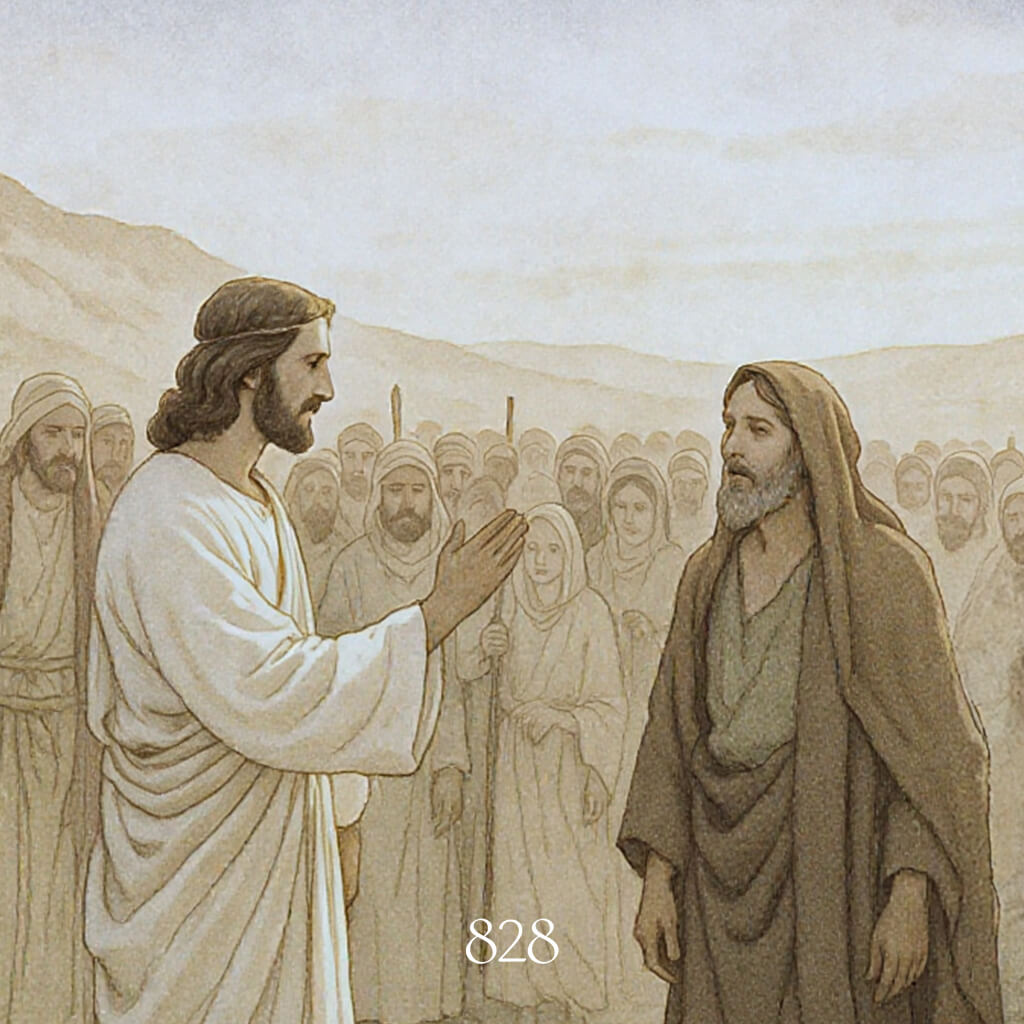
Jesus heard those words and turned to Jairus. He said, "Do not be afraid. Only believe, and she will be healed." When they arrived at the house, mourners were already weeping loudly. Jesus told them the child was not dead but sleeping, and they laughed at Him. He put them all out, took the girl by the hand, and said simply, "Child, arise." Her spirit returned. She stood up immediately and walked. Jesus then told her parents to give her something to eat.

What the messenger called finished, Jesus brought back to life. The same Jesus who spoke life into that moment speaks the same words into yours today.

What It Means

"Do not be afraid" (μὴ φοβοῦ / mē phobou)

Phobou means to fear or to be alarmed. The present imperative with the negative mē means to stop continuing in fear. This is not a rebuke for feeling afraid but a reassuring command from the One who holds the situation in His hands. Jesus does not dismiss what you are afraid of. He says "do not be afraid" because His presence in the situation is greater than every reason for fear.

"Only believe" (μόνον πίστευσον / monon pisteuson)

Monon means only, alone, and nothing but. Pisteuson is the aorist imperative of pisteuō, meaning to trust and to have faith. Together these words form a focused invitation to put down everything else and trust Jesus alone.

"She will be healed" (σωθήσεται / sōthēsetai)

Sōthēsetai comes from sōzō, meaning to save, to heal, and to deliver. The meaning of the word is more than physical recovery. It describes total restoration, life returned, everything lost now given back. Jesus was not promising that the girl would simply be alive again. He was declaring that she would be whole.

Claim This Promise

I declare that the words of Luke 8:50 are true in my life.

  • • His presence is greater than every reason I have to fear.
  • • I will not be afraid. I will only believe.
  • • Jesus speaks into what the world calls finished.
  • • Jesus brings life where others see an ending.
Today's Prayer

Jesus,

Thank You that You speak into the moments the world calls too late. You do not turn away from despair. You turn toward it.

I have at times received news that took all hope away. I have heard the voice that says it is over, that there is nothing left to hope for, that I should stop troubling You with what cannot be changed.

Today, You tell me, "Do not be afraid. Only believe."

Help me to shift my gaze. When everything I see confirms that the situation is hopeless, remind me that You took a dead girl by the hand and told her to get up. When the world's verdict is loudest, remind me that Your voice speaks a greater truth.

I set aside what my eyes see and what my circumstances tell me. I trust You alone. You are the One who brings life where I see only an ending.

In Your name I pray, Amen.

Share This Message

Do you know someone who has received news that feels like the end? Someone whose hope has collapsed and who cannot see a way forward?

Share this with them and say, "Jesus is speaking into your situation right now: do not be afraid, only believe." Your simple act of sharing could be the moment they turn from despair and receive hope from Jesus.

See more: Luke 8:50
eight two eightAdmin

Posted in FOR YOUR SOUL

Mark 5:34 verse card

A Message Has Arrived for You

These are God's promises for you today:

"Daughter, your faith has made you well"

"Go in peace"

"Be cured of your disease"

Have you been suffering in silence, wondering if anyone sees you?

God sees you and understands what you ...

Deep Dive

The Story Behind The Verse: The Touch That Stopped Jesus
Mark 5:34 - Story Behind the Verse

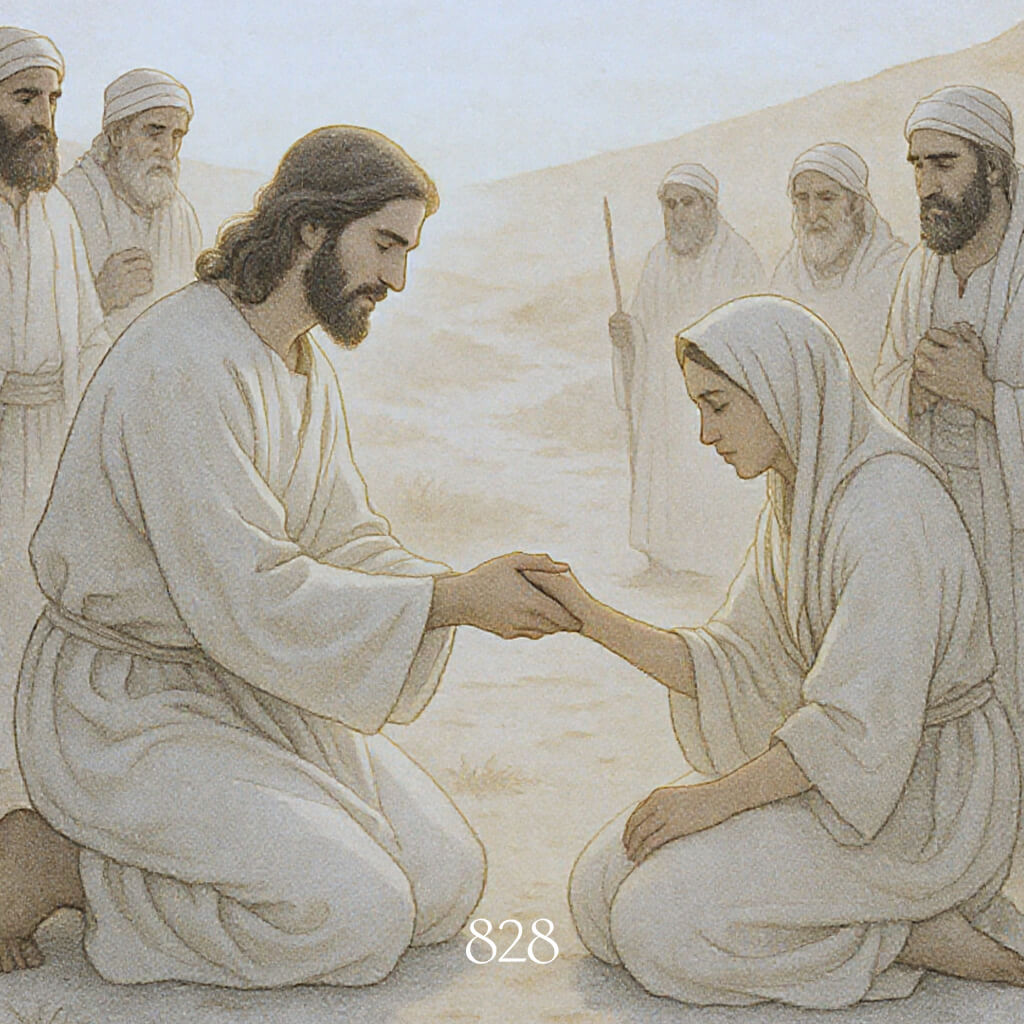
In Israel, a woman with a bleeding condition was considered ceremonially unclean. She could not touch anyone without making them unclean as well. She could not worship in the synagogue or gather with her community. For most people, this would last a few days. For the woman mentioned in Mark 5:34, it lasted twelve years. For twelve years, she was isolated from her community. She had spent everything she had receiving medical treatment, yet instead of getting better, her condition only grew worse. Her illness had cost her health, societal status, and finances.

When she heard that Jesus was passing through, she pushed through the crowd and touched the edge of His cloak. Immediately, the bleeding stopped. Twelve years of suffering ended in a single moment.

Jesus was on His way to heal a synagogue leader's daughter, who was dying. Time was of the essence. Yet He stopped. He turned and asked, "Who touched me?" At that moment, a large crowd was pressed around Him on every side. Jesus was not asking a literal question but was asking about the person of faith who had just reached out to be healed. He would not move on until He found this person. In the middle of an urgent mission, surrounded by a crowd, Jesus made time for one woman of faith who was invisible to everyone else.

She came forward trembling and told Him everything. He said to her, "Daughter, your faith has made you well." Her faith in reaching out to touch the edge of Jesus' cloak was what had healed her. When Jesus called her "Daughter," He spoke of her identity. She was no longer the unclean woman. She was a daughter of God. Jesus' healing ended her twelve years of isolation and restored her health, her identity, and her place in society among others. The same Jesus who stopped for one woman in a crowd sees you today. When you reach out to Him in faith, He meets you, heals you, and restores what was lost.

What It Means

"Daughter" (θυγάτηρ / thygatēr)

Thygatēr means daughter. This is the only recorded instance in the Gospels where Jesus addresses someone as "Daughter." For twelve years, this woman had been defined by her condition. She was the unclean woman. When Jesus healed her, Jesus also gave her a new identity by calling her "daughter." He was welcoming her back and providing a sense of belonging.

"Your faith has made you well" (ἡ πίστις σου σέσωκέν σε / hē pistis sou sesōken se)

Pistis means faith or trust. Sesōken comes from sōzō, which means to save, to heal, and to make whole. Jesus does not say "My power has healed you." He says, "Your faith has made you well." Her faith is what connected her to His healing. She believed before she was healed, and she acted on that belief by reaching out and touching His cloak.

"Go in peace" (ὕπαγε εἰς εἰρήνην / hypage eis eirēnēn)

Eirēnē means peace and echoes the Hebrew shalom, which speaks of wholeness and well-being in every area of life. Jesus is not just saying goodbye. He is sending her into a new chapter of her life. For twelve years, she had no peace. Now she is released to live life fully. She can live freely among others.

"Be cured of your disease" (ἴσθι ὑγιὴς ἀπὸ τῆς μάστιγός σου / isthi hygiēs apo tēs mastigos sou)

Hygiēs means whole, sound, and healthy. Mastix means affliction, suffering, or disease. Jesus does not say "Feel better" or "Manage your condition." He declares her completely restored. The affliction that defined her life for twelve years is finished.

Claim This Promise

I declare that the words of Mark 5:34 are true in my life.

  • • Jesus sees me.
  • • He heals what no one else can heal.
  • • He restores me fully.
Today's Prayer

Jesus,

Thank You for seeing me.

I have at times suffered in silence, wondering if anyone noticed. I have felt invisible and isolated.

Today I receive what You spoke over the woman who touched Your cloak. You called her "Daughter." You told her that her faith had made her well. You sent her into peace.

I reach out to You in faith today. I believe that You see me. I believe that You are willing to pause everything to meet me where I am. I believe that Your healing has power to change every aspect of my life.

Jesus, restore to me the things I have lost through this time of suffering. Whatever I have lost through this season of suffering, I trust that You are able to restore it. If I have been defined by my conditions, remind me of my identity as a child of God.

Thank You that You welcome those who reach out to You. Thank You that my faith connects me to Your healing.

In Your name I pray, Amen.

Share This Message

Do you know someone who has been suffering in silence? Someone who feels invisible in their pain?

Share this with them and say, "Jesus sees you. Reach out to Him in faith." Your simple act of sharing could remind them of Jesus' compassion for them.

See more: Mark 5:34
eight two eightAdmin

Posted in FOR YOUR SOUL


James 5:14-15 verse card


A Message Has Arrived for You

These are God's promises for you today:

"Call for the elders of the assembly"

"They will pray over you"

"The prayer of faith will heal the sick"

"The Lord will raise you up"

Have you ever been sick and hesitated to ask others ...

Deep Dive

The Story Behind The Verse: A Call to the Sick
James 5:14-15 - Story Behind the Verse

James wrote this letter to Jewish believers who were scattered throughout the Roman Empire. They were facing trials of many kinds, including persecution, poverty, and sickness. In the closing chapter of his letter, James addresses those who are sick and gives them a specific instruction.

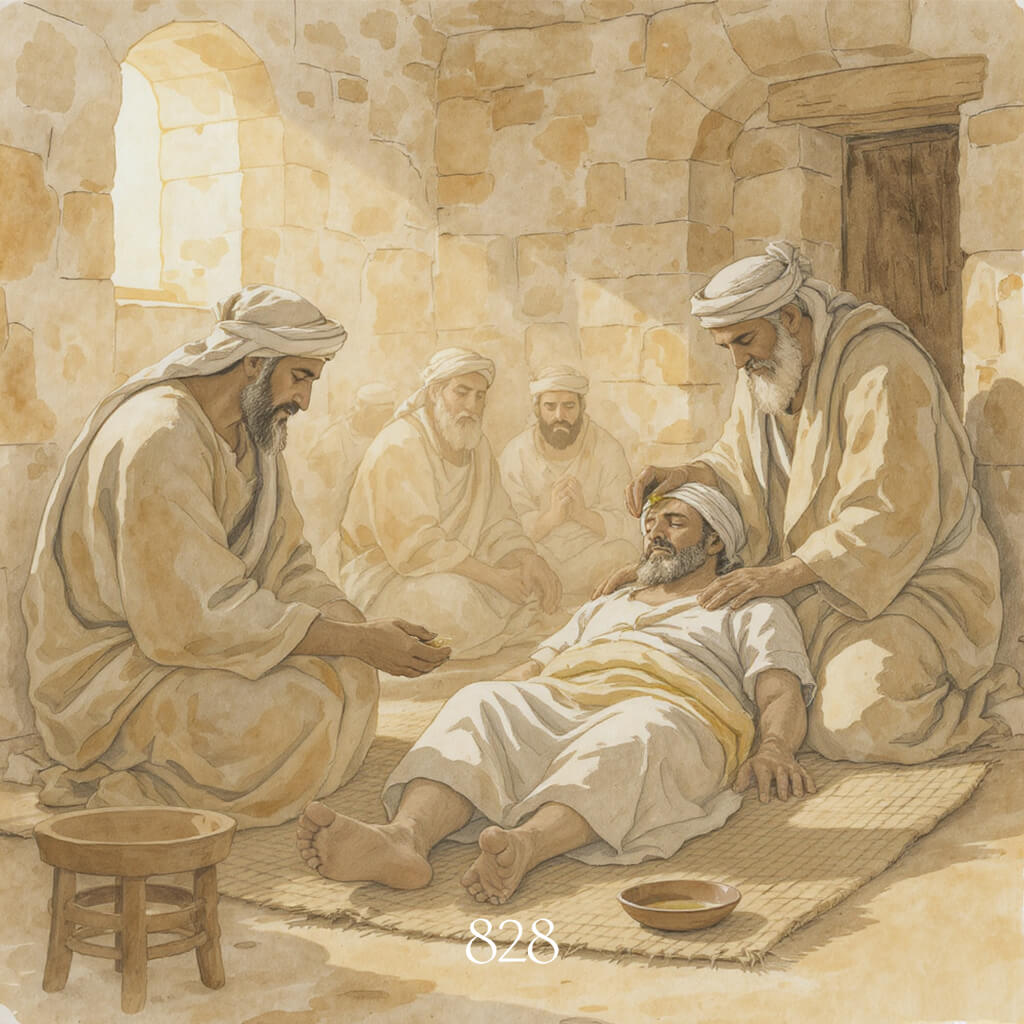
He does not tell them to endure it alone. He does not tell them to pray harder on their own. He tells them to call for the elders of the assembly. The sick person takes the first step by reaching out. Then the elders come and pray over them, anointing them with oil in the name of the Lord.

Anointing with oil was a common practice in the early church. Oil was used both as medicine and as a symbol of the Holy Spirit's presence. When the elders anointed the sick person with oil, it was an act of faith that invited God's healing power into the situation. Then comes the promise: the prayer of faith will heal the sick, and the Lord will raise them up.

James gives this instruction because God designed the church to be a place where the sick are cared for and prayed over. When you are sick, you are not meant to carry it alone. God has placed people around you who can pray over you in faith, and He promises to respond.

What It Means

"Is any among you sick?" (ἀσθενεῖ τις ἐν ὑμῖν / asthenei tis en hymin)

Astheneo means to be weak, to be sick, or to lack strength. James addresses anyone in the community who is experiencing illness or physical weakness.

"Let him call for the elders" (προσκαλεσάσθω τοὺς πρεσβυτέρους / proskalesastho tous presbyterous)

Proskalesastho means to call to oneself, to summon, to invite to come. The sick person is the one who initiates. Presbyterous refers to the elders, the mature leaders of the assembly who carry spiritual authority. Those who are in need can reach out and call for those who can pray over them.

"Anointing him with oil" (ἀλείψαντες ἐλαίῳ / aleipsantes elaio)

Aleipho means to anoint or to apply oil. Elaion is olive oil. In the early church, anointing with oil was an act of faith and care, symbolizing the Holy Spirit's presence and God's healing power. It was done in the name of the Lord, meaning it was carried out under His authority.

"The Lord will raise him up" (ἐγερεῖ αὐτὸν ὁ κύριος / egerei auton ho kyrios)

Egeiro means to raise up, to lift, to restore to health. The subject is the Lord. He is the one who raises the sick person up. The sick person calls, the elders pray, and the Lord heals.

Claim This Promise

I declare that the words of James 5:14-15 are true in my life.

  • • When I am sick, I will call for the elders of the assembly.
  • • I will let them pray over me.
  • • God will heal me through the prayers of faith.
  • • The Lord will raise me up.
Today's Prayer

God,

Thank You for providing a way for healing through the prayers of others.

I have at times tried to endure sickness on my own. I have hesitated to reach out and ask others to pray for me.

Today I receive the instruction James gave. When I am sick, I will call for the elders of the assembly. I will let them pray over me. I trust that You respond to the prayer of faith and that You will heal me.

Thank You that You placed leaders in the church who can pray over me in faith. Thank You for hearing and responding to prayer.

In Jesus' name I pray, Amen.

Share This Message

Do you know someone who is sick and carrying it alone?

Share this with them and say, "Call for the elders of the assembly and let them pray over you. The prayer of faith will heal the sick." Your simple act of sharing could encourage them to reach out and receive prayer.

See more: James 5:14-15
eight two eightAdmin

Posted in FOR YOUR SOUL

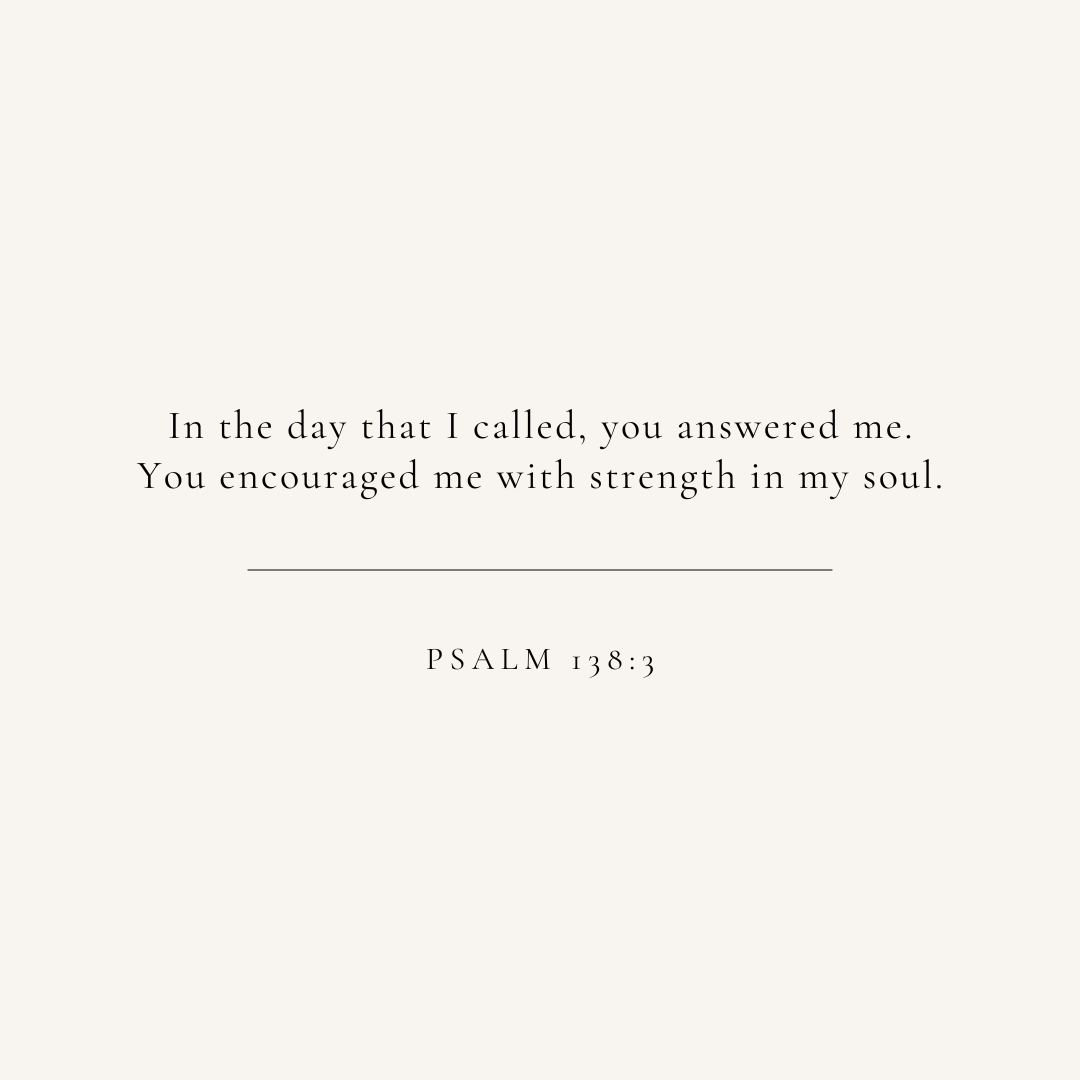
Psalm 138:3 verse card

A Message Has Arrived for You

These are God's promises for you today:

"In the day you call, I will answer you"

"I will encourage you”

"I will give strength to your soul"

Have you been praying about something for a long time and wondered whether God hears ...

Deep Dive

The Story Behind The Verse: A Psalm of Praise Rooted in Experience
Psalm 138:3 - Story Behind the Verse

Psalm 138 is a psalm of wholehearted praise. He praises God for His love and faithfulness. This is the praise of someone who has truly experienced what he is declaring.

Verse 3 says, "In the day that I called, you answered me. You encouraged me with strength in my soul." David is speaking of a lived experience of calling out to God and receiving an answer. Through the experience, David was strengthened from the inside out.

In verses 4 and 5, Psalm 138 moves from personal experience to universal praise, from one man's answered prayer to the greatness of God whom all the earth will one day acknowledge. David envisions the kings of the earth hearing what God has done and giving praise to God.

Then in verses 6 and 7, David declares something that sits at the heart of who God is. Though God is exalted and great, He sees and draws near to those who are lowly. He does not look away from the humble. And when His people walk through trouble, He reaches out to them and helps them. Psalm 138 closes with trust in a God whose love never fails and who will complete what He has begun in each person who calls on Him.

What It Means

"In the day that I called" (בְּיוֹם קָרָאתִי / beyom karati)

Qara means to call out and to cry for help with urgency. Beyom means in the day or at that time, pointing to a specific moment of genuine need. David is describing the desperate cry of someone who has no other options.

"You answered me" (וַתַּעֲנֵנִי / vata'aneni)

Anah means to answer and to respond directly. The past tense here expresses a completed action. He is giving testimony about what already happened. He called, and God responded to his cry.

"You encouraged me" (תַּרְהִבֵנִי / tarhiveni)

Tarhiveni Tarhiveni comes from the root rahav, which means to make bold or to strengthen. When God answered David, He encouraged him with strength in his soul, giving him boldness to stand and to continue. God's answer was not only a change in David's circumstances but strength in his soul to endure them.

"With strength in my soul" (בְנַפְשִׁי עֹז / venafshi oz)

Nephesh means soul, life, and the core of a person's inner being. Oz means strength, might, and power. God's response reached David at the deepest level of his being and strengthened him from the inside.

Claim This Promise

I declare that the words of Psalm 138:3 are true in my life.

  • • God hears my prayers.
  • • When I call Him, God answers me.
  • • God provides strength to my soul.
Today's Prayer

God,

Thank You for answering when I call.

I have at times wondered whether You heard my prayers. I felt discouraged when I had prayed about the same situation for a long time and nothing seemed to change.

Today I hold on to what David declared. He called out to You, and You answered him. You gave him strength in his soul.

When my prayers are not yet answered, I will keep praying and waiting for Your answer. When my circumstances have not yet changed, I trust that You are at work. When I feel discouraged, remind me that You are near to those going through difficult times.

I trust that You hear me and that Your answer will come at the right time.

In Jesus' name I pray, Amen.

Share This Message

Do you know someone who has been waiting on God and needs encouragement to keep praying?

Share this with them and say, "God hears your cry and He will answer you." Your simple act of sharing could be the encouragement they need to keep calling out to God.

See more: Psalm 138:3
eight two eightAdmin

Posted in FOR YOUR SOUL


Psalm 147:3 verse card

A Message Has Arrived for You

These are God's promises for you today:

"I heal the broken in heart"

"I bind up their wounds"

Have you ever wondered whether God sees your pain?
He sees you. He wants to heal what has been broken and bind up your wounds. He ...

Deep Dive

The Story Behind The Verse: A Song of Praise from the Other Side
Psalm 147:3 - Story Behind the Verse

Around 515 BC, the Jewish exiles were finally returning home from Babylon after nearly fifty years of captivity. Their city had been destroyed, their temple burned, and everything familiar was gone.

Psalm 147 is a song of praise that rises out of that context. The psalm praises God as the one who gathered the exiles and brought them home. As the exiles return, healing is happening at the national level. God also heals at the individual level, tending to those who are broken in heart and binding up their wounds.

The psalm then declares that God numbers every star and calls each one by name. His understanding has no limit. He is great in power. He lifts up the humble and brings the wicked low. The psalm goes on to praise God as provider, sustainer, and protector. He gives rain, grows food, strengthens the gates of His people, and brings peace. He is powerful enough to command the forces of nature and personal enough to delight in those who trust Him.

Psalm 147 is the praise of people who discovered that the God who governs the cosmos had been watching over them through every year of their suffering. And now, standing on the other side, all they could do was praise. The God they praised is the same God who tends to your heart today.

What It Means

"He heals the broken in heart" (רוֹפֵא לִשְׁבוּרֵי לֵב / rofe lishvurei lev)

Rofe is a participle meaning "healer," describing not just what God does but who He is. Shavar means to break or shatter, often used to describe something broken beyond repair. Lev means heart, the core of a person's thoughts, emotions, and will. God is the healer of those whose hearts are deeply broken, wounded in ways that feel beyond human repair.

"And binds up their wounds" (וּמְחַבֵּשׁ לְעַצְּבוֹתָם / umkhabesh le'atzevotam)

Chavash means to bind or bandage, often used to describe the care of wounds. This describes intentional and attentive care. Atzevot means pains, sorrows, or griefs. God does not simply acknowledge your pain from a distance. He meets you where you are and tends to your pain with care.

Claim This Promise

I declare that the words of Psalm 147:3 are true in my life.

  • • God sees me and cares for me.
  • • God heals my broken heart.
  • • God binds up my wounds.
Today's Prayer

God,

Thank You that I am seen and loved by You.

I have at times wondered whether You truly cared about what I was going through, but today I receive Your truth. There are places in me that have been broken for a long time, and I have wondered whether healing was truly possible.

Today I hold on to the truth of this psalm: You are the God who heals the broken in heart and tends to their wounds. You are the God who restored an entire nation from captivity, and You are the same God who tends to one broken heart. Nothing is beyond Your reach and nothing is too small for Your care.

I trust You with what is broken in me. Heal my broken heart.
Tend to the places that feel beyond repair.

In Jesus' name I pray, Amen.

Share This Message

Do you know someone who feels invisible in their pain?

Share this with them and say, "God sees your pain, and He cares for you deeply. He will bring you healing." Your simple act of sharing could be the reminder they need that they are seen, known, and tenderly cared for.

See more: Psalm 147:3
eight two eightAdmin

Posted in FOR YOUR SOUL

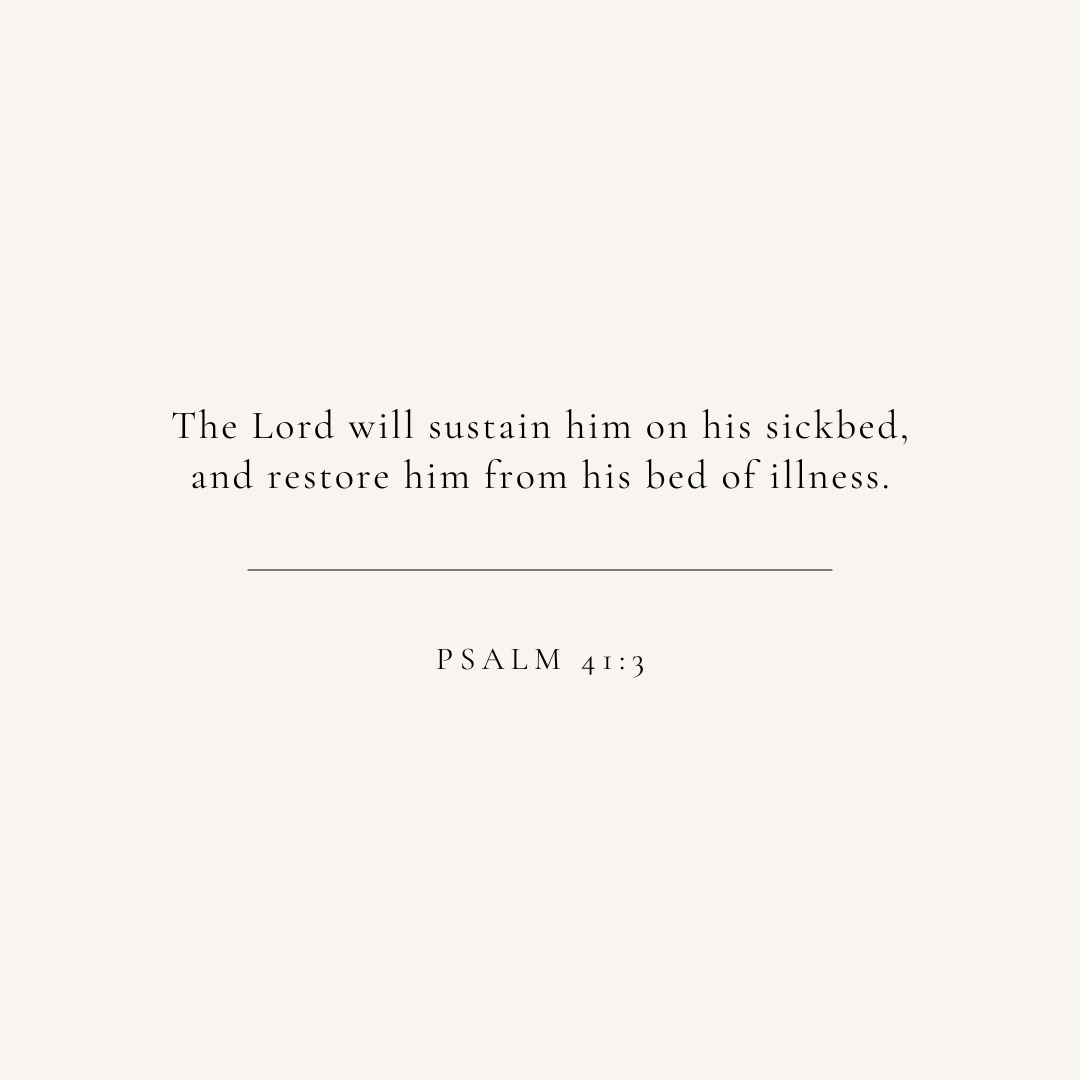
Psalm 41:3 verse card

A Message Has Arrived for You

These are God's promises for you today:

"I will sustain you on your sickbed"

"I will restore you from your bed of illness"

Have you ever felt alone in your struggles?

There are seasons when you find yourself with no one to le...

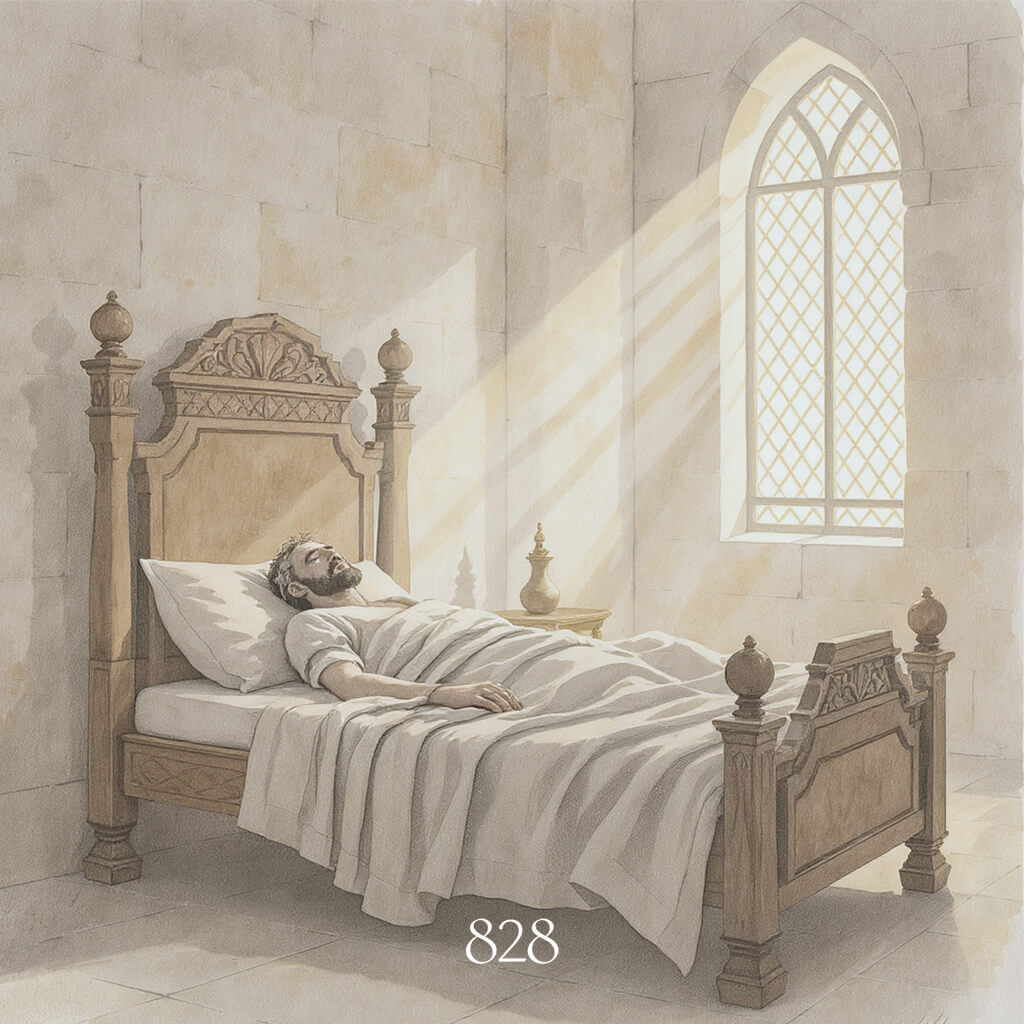
Deep Dive

The Story Behind The Verse: When God Stays
Psalm 41:3 - Story Behind the Verse

Psalm 41 opens with a picture of a particular kind of person. David describes someone who looks upon the weak and vulnerable and responds with intention and compassion. To this person, David declares, God promises many blessings. God promises to deliver them in times of trouble, to protect and preserve them, and to sustain and restore them from illness. The blessings of verses 1 to 3 are promised to those who care for others.

Then the psalm takes an unexpected turn. David himself becomes the vulnerable one. He is sick and bedridden. What he finds is devastating. In verses 5 to 8, his enemies predict his death, those who visited come with false sympathy, and even a close friend he had deeply trusted turns against him. David was completely alone.

Yet it is precisely here, in this place of abandonment and illness, that the promises in the earlier verses of Psalm 41 shine most clearly. When David had no one to turn to, God was right beside him and was faithful to every promise He had made.

In verses 10 to 12, David turns to God. He asks God to raise him up. The psalm closes with David standing in God's presence, restored and vindicated. Psalm 41 is the story of a man who cared for those in need, only to find himself in need, and to discover that the God he trusted never left his side. The same God who stayed beside David when he was sick is present with you today.

What It Means

"Yahweh will sustain him" (יִסְעָדֶנּוּ / yis'adenu)

The Hebrew word saad means to support, to sustain, and to strengthen. It describes strength given to someone who cannot stand on their own. When David was left with no one to lean on, God's sustaining presence remained.

"On his sickbed" (עַל־עֶרֶשׂ דְּוָי / al-eres devai)

Eres means bed, and devai means sickness or illness. Together they describe the place of weakness and vulnerability. The promise is that God sustains you even there in the very place where you are weak. David was abandoned by those around him, yet God sustained him where he was.

"And restore him" (הָפַכְתָּ / hafakhta)

Hafakh means to turn. It is the same word used in Psalm 30:11, "You have turned my mourning into dancing." For David, this meant not only physical recovery but also restoration before his enemies. God's work brings about real change, turning a condition of weakness into one of restored strength.

"From his bed of illness" (כָּל־מִשְׁכָּבוֹ / kol-mishkavo)

Kol means all or every, and mishkav means bed or place of lying down. Together they refer to the whole time David lay on his sickbed. God is not present for only a moment but through the entire time of illness from beginning to end.

Claim This Promise

I declare that the words of Psalm 41:3 are true in my life.

  • • God sustains me on my sickbed.
  • • God restores me from my bed of illness.
  • • God is always by my side.
  • • God is faithful to every promise He has made to me.
Today's Prayer

God,

Thank You for being right beside me, sustaining me even in my weakest moments.

I have at times felt alone. I have felt unseen and unsupported, as though no one truly understood what I was carrying. Today I hold on to the truth of what David experienced: even when every human support was gone, You remained. You are faithful to every promise You have made, and You stayed by his side.

Sustain me in this season. When I feel weak, be the strength that carries me. When I am sick, restore me to health. When I feel alone, remind me that You are beside me.

Restore me both physically and spiritually. Give me hope, purpose, and joy. Turn this season of struggle into a testimony of Your faithfulness.

You sustain me. You restore me. I trust You God.

In Jesus' name I pray, Amen.

Share This Message

Do you know someone who is sick and feels alone in their suffering? Someone who wonders whether God truly sees them in their pain?

Share this with them and say, "God is right beside you. He sustains you and will restore you." Your simple act of sharing could be the reminder they need that the God who was always with David will be with them as well.

See more: Psalm 41:3
eight two eightAdmin

Posted in FOR YOUR SOUL

Psalm 30:2 verse card

A Message Has Arrived for You

These are God's promises for you today:

"I hear you when you cry out to Me"

"I will heal you"

Have you ever felt so hurt and desperate that crying out was all you could do?

In moments like these, God wants you to seek Him and...

Deep Dive

The Story Behind The Verse: From Desperate Cry to Songs of Praise
Psalm 30:2 - Story Behind the Verse

David wrote Psalm 30 for the dedication of the temple in Jerusalem. The superscript describes it as "A Song for the Dedication of the Temple." It was composed as a song of celebration, marking a significant moment of worship and restoration.

David opens the psalm by describing a season of suffering. He had been brought low, so low that he described it as descending toward Sheol, the realm of the dead. In that dark place, he cried out to God. And God heard him and brought him up.

Psalm 30 goes beyond the time of suffering to the time of restoration. In verse 4, David calls others to join him in praise, declaring that God's favor lasts a lifetime. Though weeping may last through the night, joy comes in the morning.

In verses 8 and 9, we see something beautiful about how David approached God in his struggle. He did not simply ask for relief. He expresses his desire to glorify God, asking what purpose his death would serve and who would then declare God's faithfulness. David's heart even in hardship was turned toward God's glory.

And then in verses 11 and 12, the full picture of restoration unfolds. God turned his mourning into dancing. The sackcloth of grief was removed and he was clothed with joy. David could no longer stay silent. His heart had to sing.

Psalm 30 is a testimony of God's healing. David looked back at what he had been through and declared that God had restored him completely, not just physically but in joy, in praise, and in purpose. The God who healed and restored David is the same God who is ready to heal and restore you today.

What It Means

"Lord my God" (יְהוָה אֱלֹהָי / Yahweh Elohai)

Yahweh is God's covenant name, revealed to Moses as "I AM WHO I AM" (Exodus 3:14). Elohai means "my God," making this expression deeply personal. David is not addressing a distant or unfamiliar deity. He is calling on his own God, the One who knows him by name and has made a covenant with him. This combination of names expresses both the greatness of God and the closeness of their relationship.

"I cried to you" (שִׁוַּעְתִּי / shivvati)

Shivvati comes from the root shawa, which means to cry out loudly for help. Shawa is the cry of someone in crisis when strength is gone and desperation takes over. David brought his honest need before God, and God responded.

"And you have healed me" (וַתִּרְפָּאֵנִי / vatirpa'eni)

Rapha means to heal and to restore to wholeness. In Exodus 15:26, God revealed Himself as Yahweh Rapha, the God who heals. The word vatirpa'eni is past tense, describing a completed action. David is not expressing hope for future healing. He is testifying to healing already received. What God did for David becomes the promise for those who cry out to Him today.

Claim This Promise

I declare that the words of Psalm 30:2 are true in my life.

  • • The Lord is my God, and He hears my cry.
  • • God heals me completely.
  • • This season will become a testimony of God's healing power.
Today's Prayer

God,

Thank You that You hear my cry and that You are the God who heals.

Today I receive the testimony of David. When he cried out to You in desperation, You heard him, healed him, and turned his mourning into dancing.

I cry out to You now. My body needs healing. My heart carries wounds I have not been able to mend on my own. My soul is weary. Hear me, God.

When healing feels far away, remind me that You are Yahweh Rapha, the God who heals. When I cannot see past this season of pain, remind me that joy comes in the morning.

When I look back on this season, may I praise You. May what I am walking through become a testimony of Your faithfulness. Like David, may I one day stand and declare that You turned my mourning into dancing.

You are the God who heals, and I trust You. Thank You for Your faithfulness.

In Jesus' name I pray, Amen.

Share This Message

Do you know someone who has cried out to God and is waiting to know if He truly hears?

Share this with them and say, "God hears your cry." Your simple act of sharing could be the reminder they need that the God who heard David hears them too.

See more: Psalm 30:2
eight two eightAdmin

Posted in FOR YOUR SOUL

Ezekiel 37:5 verse card

A Message Has Arrived for You

These are God's promises for you today:

"I will cause breath to enter into you"

"You will live"

What are the areas in your life that feel lifeless? Perhaps it is a relationship, your family, your career, your health, or some...

Deep Dive

The Story Behind The Verse: Life from Dry Bones
Ezekiel 37:5 - Story Behind the Verse

The prophet Ezekiel spoke these words while living among the Jewish exiles in Babylon. Jerusalem had been destroyed. The temple had been burned to the ground. The survivors had been taken far from home as captives. Everything they knew was gone. The people described how they felt: "Our bones are dried up, and our hope is lost. We are completely cut off" (Ezekiel 37:11). They saw no possibility of restoration, no reason to hope, and no future.

It was in this moment that God gave Ezekiel a vision. He brought Ezekiel to a valley filled with dry bones. These bones had no sign of life. God asked Ezekiel, "Son of man, can these bones live?" Ezekiel answered, "Lord, You know." Ezekiel surrendered what he did not know to the One who already knew.

Then God commanded Ezekiel to prophesy over the dry bones, "I will cause breath to enter into you, and you will live." Ezekiel obeyed. As he prophesied, there was a noise and the bones came together. Sinews appeared, flesh grew, and skin covered them. Yet there was still no breath in them. Then God told Ezekiel to prophesy to the breath. When the breath entered, they came to life and stood up on their feet as an exceedingly great army.

The same God who breathed life into dry bones speaks over whatever feels lifeless in your life today. When His breath enters, you will live.

What It Means

"The Lord says" (אֲדֹנָי יְהוִה / Adonai Yahweh)

Adonai means Lord, Master, and Sovereign. Yahweh is the covenant name of God, the name He revealed to Moses as "I AM WHO I AM." When these names appear together, they reveal both God's authority and His covenant faithfulness toward His people. When God speaks, His word carries the power to create the very reality it declares.

"Breath" (רוּחַ / ruach)

Ruach can mean breath, wind, or spirit depending on the context. The same word describes the Spirit of God moving over the waters at creation (Genesis 1:2). In Scripture, ruach is the life giving breath that comes from God Himself. When God's ruach enters, life begins where there was none before.

"I will cause to enter into you" (בָּכֶם / bakhem)

Bakhem means "into you." God places His breath within you so that His Spirit becomes the source of life from the inside out. Every action in this phrase belongs to God. The emphasis is entirely on what God does.

"You will live" (וִחְיִיתֶם / vichiyitem)

The Hebrew verb chayah means to live, to be restored, and to revive. It is life that has been restored after death or ruin. In the vision, the bones do not simply move or regain function. They stand up as an exceedingly great army, fully alive and ready to act. God's promise is restoration of abundant life.

Claim This Promise

I declare that the words of Ezekiel 37:5 are true in my life.

  • • God breathes life into me.
  • • God renews and restores my life.
  • • I will live.
Today's Prayer

God,

Thank You for promising to breathe life into me.

I have at times felt like there was nothing left. The passion had faded. I felt hopeless. I tried to revive myself by my own strength and could not.

Today I receive Your word, "I will cause breath to enter into you, and you will live." Breathe Your breath into me. When I have given up hope, remind me that You spoke life into dry bones and they stood up as an army.

Thank you that life comes from You.

In Jesus' name I pray, Amen.

Share This Message

Do you know someone who has lost the passion or hope they once had?

Share this with them and say, "God promises to breathe life into you. You will live." Your simple act of sharing could remind them that God brings life to what seemed beyond restoring.

See more: Ezekiel 37:5
eight two eightAdmin

Posted in FOR YOUR SOUL

Ezekiel 36:26 verse card

A Message Has Arrived for You

These are God's promises for you today:

"I will give you a new heart"

"I will put a new spirit within you"

"I will take away the heart of stone and give you a heart of flesh"

Have you ever noticed that your heart is not what ...

Deep Dive

The Story Behind The Verse: A New Heart for a Hardened People

The prophet Ezekiel spoke these words to the Jewish exiles in Babylon. Jerusalem had been destroyed. The temple had been burned to the ground. The survivors had been taken as captives from their homes. Everything they knew was gone.

Before the exile, Israel had gradually turned away from God. Their hearts had slowly hardened, becoming less and less responsive to God's voice. Into this place of spiritual numbness, God gave Ezekiel this promise, "I will also give you a new heart, and I will put a new spirit within you. I will take away the heart of stone from your flesh and give you a heart of flesh" (Ezekiel 36:26).

In this promise, God says, "I will take away. I will give you." Every action in this promise belongs to God. The same God who promised new hearts to a people in exile promises the same to you today. All you need to do is to come to Him and receive it.

What It Means

"A new heart" (לֵב חָדָשׁ / lev chadash)

Lev means heart, the center of a person's inner life where decisions, desires, and devotion are formed. Chadash means new, fresh, something that did not exist before. He promises to give a heart that is entirely new. This new heart is able to love Him, respond to His word, and walk in His ways.

"A new spirit" (רוּחַ חֲדָשָׁה / ruach chadashah)

Ruach means spirit, breath, or the inner life that animates a person. It refers to the unseen life within a person that shapes how one thinks, desires, and lives. Just as God promises a new heart, He also promises a renewed spirit within us. This points to a deep inward transformation that reaches beyond outward behavior. The inner life is renewed so that the heart can now respond to Him.

"Heart of stone" (לֵב הָאֶבֶן / lev ha'even)

Even means stone or rock. In Hebrew culture, stone represents what is hard, unresponsive, and unable to change. A heart of stone does not respond to God or to His word. It cannot be softened by any human effort. Only God can remove it.

"Heart of flesh" (לֵב בָּשָׂר / lev basar)

Basar means flesh, living tissue. While a stone is rigid and is not able to change, a heart of flesh is alive and responsive to God. It can receive grace and be moved by God's presence.

"I will take away... I will give" (וַהֲסִרֹתִי... וְנָתַתִּי / vahasiroti... venatatti)

Hasiroti means I will remove or take away completely. Natatti means I will give or place. The subject of every action in this promise is God Himself. He is the one who removes and the one who gives. The transformation of the heart does not begin with human effort. It begins with the grace of God.

Claim This Promise

I declare that the words of Ezekiel 36:26 are true in my life.

  • • God is giving me a new heart and a new spirit.
  • • God is taking away the heart of stone within me.
  • • God is giving me a heart of flesh that responds to Him.
  • • This does not come from my effort. It is God's gift of grace.
Today's Prayer

God,

Thank You for promising me a new heart and a new spirit.

Today I receive Your promise. Take away the heart of stone within me and give me a heart of flesh. Give me a heart that can love, forgive, and respond to You and others.

When my heart becomes unresponsive, help me to become aware of this, come before You, and receive a new heart from You.

Place a new spirit in me. With this new spirit, may I follow Your ways and go where You are leading me. Give me the spirit I need for the challenges of this season.

I am ready to receive from You. Thank you for making me new.

In Jesus' name I pray, Amen.

Share This Message

Do you know someone who wants to change but cannot seem to do it on their own?

Share this with them and say, "God promises to give you a new heart and a new spirit." Your simple act of sharing could remind them that God is the one who makes hearts new.

See more: Ezekiel 36:26
eight two eightAdmin

Posted in FOR YOUR SOUL


2 Corinthians 5:17 verse card


A Message Has Arrived for You

These are God's promises for you today:

"If anyone is in Christ, he is a new creation"

"The old things have passed away"

"All things have become new"

When you come to believe in Christ, you are made new, and who you once were...

Deep Dive

The Story Behind The Verse: A New Identity for the Corinthians
2 Corinthians 5:17 - Story Behind the Verse

The apostle Paul wrote these words to the church in Corinth around AD 55. Corinth was one of the most notorious cities in the Roman Empire. It was a wealthy trade city where sexual immorality, idol worship, and greed were the cultural norms.

Many believers in the Corinthian church came from this background. Some were paralyzed by guilt, feeling like they could not escape who they used to be. Others were falling back into their old ways. Still others were judging each other for their pasts. The Corinthian believers were defining themselves by their past and their struggles.

To address this, Paul writes, "Therefore if anyone is in Christ, he is a new creation. The old things have passed away. Behold, all things have become new." To these believers, Paul is telling them that God has already made them new. Their old identity has no claim on them anymore. The same is true for anyone who believes in Christ and belongs to Christ. The same declaration is for you today. God says you are a new creation in Christ.

What It Means

"In Christ" (ἐν Χριστῷ / en Christō)

The phrase en Christō means "in Christ" or "within Christ." Throughout the letters of Paul the Apostle, this expression describes union with Christ. To be "in Christ" means that your life and identity are now joined to His. Your standing before God is no longer determined by your past or your efforts, but by your relationship to Christ.

"New creation" (καινὴ κτίσις / kainē ktisis)

Greek has two common words for "new." Neos refers to something new in time, while kainos describes something new in kind or quality. Paul intentionally uses kainos to emphasize that God has done more than improved what was there before. The word ktisis means creation. Together, the phrase "new creation" declares that God has performed a creative work in you, giving you a new identity in Christ.

"The old things have passed away" (τὰ ἀρχαῖα παρῆλθεν / ta archaia parēlthen)

Archaia refers to the old or former things that once defined a person's life. The verb parēlthen means "passed away" or "gone," indicating that something has decisively come to an end. Paul is describing a real turning point in identity. The old order of life no longer holds authority over the believer. This means that what once defined you no longer determines who you truly are before God.

"All things have become new" (γέγονεν καινά / gegonen kaina)

The verb gegonen is written in the perfect tense, which describes an action completed in the past with results that continue into the present. In other words, something decisive has already happened and its effects remain. The new life God has given continues to define your standing before Him.

Claim This Promise

I declare that the words of 2 Corinthians 5:17 are true in my life.

  • • In Christ, I am a new creation.
  • • The old things have passed away.
  • • All things have become new.
  • • My identity is defined by what God says about me.
Today's Prayer

God,

Thank You for declaring me a new creation in Christ.

I have often defined myself by my struggles instead of by Your word. I have at times believed that I could never truly change.

Today I receive Your declaration. I am a new creation. The old has passed away. Through Christ, all things have become new.

When my past tries to define me, remind me that the old has passed away. When I stumble and fall into old patterns, remind me that my identity in You has not changed. I am still a new creation because I am in Christ. Though I am covered in Your grace, may I never take it for granted and return to my old ways. May I have the discipline to grow and mature in Christ. I desire to be more like Christ every day and to let others know about Him.

Thank You that my identity is not based on my effort but on what Jesus did for me. May I live each day growing into the new creation You have already made me.

In Jesus' name I pray, Amen.

Share This Message

Do you know someone who feels defined by their past? Someone who believes they can never truly change?

Share this with them and say, "In Christ, you are a new creation. The old has passed away. All things have become new." Your simple act of sharing could remind them that God has already made them new.

See more: 2 Corinthians 5:17
eight two eightAdmin

Posted in FOR YOUR SOUL

Isaiah 53:5 verse card

A Message Has Arrived for You

These are God's promises for you today:

"Jesus was pierced for your transgressions"

"He was crushed for your iniquities"

"His punishment brought you peace"

"By His wounds you are healed"

Are you carrying guilt, pain, or wounds...

Deep Dive

The Story Behind The Verse: The Great Exchange
Isaiah 53:5 - Story Behind the Verse

Israel was waiting for a Messiah. They expected a king who would triumph over their enemies and establish God's kingdom. But when the prophet Isaiah received a vision of this Messiah, what he saw was completely different: "He was despised and rejected by mankind, a man of suffering" (Isaiah 53:3). Though these words were written on the scroll, people did not fully understand the words. They were looking for a Messiah to end their pain, but they never imagined that God's plan for healing would come through the suffering of the Messiah.

Seven centuries later, Jesus was arrested, beaten, mocked, and nailed to the cross. The crowd saw a man dying. They saw defeat. What they could not see was that this was the plan God had spoken through Isaiah all along. On the cross, the great exchange was taking place. Jesus was taking upon Himself the punishment meant for us so that we could be at peace. He bore the wounds so that we could receive healing.

This exchange is what sets the gospel apart. In other paths to healing, there are requirements to meet, levels to reach, and standards to fulfill before you can receive something. You have to first prove yourself worthy. The gospel is different. Before we did anything to deserve it, before we met any requirement, Christ gave Himself for us. Salvation was freely given. By His grace, it is a gift we receive.

At the cross, Jesus spoke His final words, "It is finished" (John 19:30). The mission He came to carry out on Earth was complete. Three days later, Jesus rose from the dead and claimed victory over death. All who believe in Christ receive this victory and have eternal life. Through Christ, we are able to draw near and live each day in fellowship with God. And when our time on Earth is complete, that fellowship continues in heaven.

What Jesus gave us through His sacrifice is for you today. His peace and His Healing are yours. The exchange has already been made. All that remains is for you to believe and receive it.

What It Means

"Jesus was pierced for our transgressions" (מְחֹלָל מִפְּשָׁעֵנוּ / mecholal mippeshaenu)

The word mecholal comes from the Hebrew root chalal, which means to pierce, wound, or profane. In this context it describes one who is grievously wounded or pierced. The word peshaʿ refers to transgression, a form of rebellion against God's authority and a crossing of the boundary He has set. Isaiah describes a Messiah who took on the sins of the people and suffered in their place.

"He was crushed for our iniquities" (מְדֻכָּא מֵעֲוֺנֹתֵינוּ / medukka me'avonotenu)

The word medukka comes from the Hebrew root daka, which means to crush and break down under great weight. It describes suffering so severe that it leaves a person crushed and afflicted. The word avon refers to iniquity and describes the guilt that result from sin. Unlike peshaʿ, which emphasizes open rebellion, avon often points to the inner burden and consequences of wrongdoing. Isaiah portrays Jesus as one who was crushed under the weight of the people's iniquity. His suffering was connected to the brokenness of those he represents.

"The punishment that brought our peace was on him" (מוּסַר שְׁלוֹמֵנוּ עָלָיו / musar shelomenu alav)

The word musar refers to discipline, correction, or chastening that follows wrongdoing. It describes discipline for the purpose of redirection and restoration. Isaiah says that this discipline fell upon Jesus. The result of this is shalom. The Hebrew word shalom describes peace as wholeness, harmony, and well being in every dimension of life. Through Jesus' suffering, the possibility of true peace was given to us.

"By his wounds we are healed" (וּבַחֲבֻרָתוֹ נִרְפָּא־לָנוּ / uvachaburato nirpa lanu)

The word chaburah refers to a wound or bruise caused by beating. It evokes the image of visible injuries inflicted through suffering. The verb rapha means to heal, restore, and make whole. In this verse it appears in a passive form, indicating that healing comes to us rather than originating from us.

Claim This Promise

I declare that the words of Isaiah 53:5 are true in my life.

  • • Jesus took the punishment in my place and gave me peace.
  • • By His wounds, I am healed.
  • • By grace through Christ, I have been restored.
Today's Prayer

Jesus,

Thank You for what You did on the cross on my behalf.

You took on the burden of my sins and gave me peace and healing. I did not earn any of this. By Your Grace, I received all this.

Because of what You did, I am no longer condemned. I have eternal life. My relationship with God has been restored. I can come before God freely and have fellowship with Him.

I will live each day being thankful for what You have done. May I live intentionally, reflecting Your Grace in how I walk with God, how I see myself, and how I treat others.

When past condemnation and guilt resurface, remind me that the exchange has already taken place. You have already paid the price for my sins.

Thank You that through You, I have peace and healing.

In Your name I pray, Amen.

Share This Message

Do you know someone who needs to hear that peace and healing are theirs to receive?

Share this with them and say, "Jesus took what we deserved and gave us peace and healing." Your simple act of sharing could remind them of the grace that is already theirs through Christ.

See more: Isaiah 53:5
eight two eightAdmin

Posted in FOR YOUR SOUL

Romans 8:11 verse card

A Message Has Arrived for You

These are God's promises for you today:

"The Spirit who raised Jesus from the dead dwells in you."

"He will give life to your mortal body."

"This same power lives in you right now."

Have you ever reached a point where you fel...

Deep Dive

The Story Behind The Verse: Living by the Spirit's Power
Romans 8:11 - Story Behind the Verse

Through Christ, we were set free from the bondage of sin and death. When Christ ascended into heaven, He sent the Holy Spirit to help and guide us.

The Holy Spirit works in us so that the salvation we received from Christ is manifested in our lives. When it comes to the Holy Spirit, it is not about putting in our best effort. It is about trusting and resting in the Holy Spirit. When we reach our limitations and realize we cannot do it on our own, we believe that the Holy Spirit is able, and we ask Him to work within us.

When we rely on the Holy Spirit and obey in faith, the Holy Spirit within us is able to work powerfully and guide us to live a new life in Christ. With the guidance of the Holy Spirit, we are filled with more ease, clarity, and peace. What once felt impossible when we relied only on our own strength becomes possible with the help of the Holy Spirit. When we are weighing many options and feel overwhelmed by decision-making, relying on the Holy Spirit and consistently reading God's Word brings clarity to see which options are better. Sometimes, after we have made a decision through much prayer, we still wonder if we chose rightly. Time will eventually reveal whether we made a good decision. Even before any results appear, we are not left alone. The Spirit himself helps us in our weakness and makes intercession for us according to God's will. Today, let us invite the Holy Spirit to guide us through the daily moments of life and experience the power of the Holy Spirit to bring change in our lives for the better.

What It Means

"The Spirit of him who raised up Jesus from the dead" (τὸ πνεῦμα τοῦ ἐγείραντος τὸν Ἰησοῦν ἐκ νεκρῶν / to pneuma tou egeirantos ton Iēsoun ek nekrōn)

"Spirit" is the Greek word pneuma, meaning breath, wind. This is the very life force of God. "Raised" is the Greek word egeirō, meaning to awaken, to bring to life. This is the power that raised Jesus' dead body out of the tomb on the third day. That resurrection power has a name: the Holy Spirit.

"Dwells in you" (οἰκεῖ ἐν ὑμῖν / oikei en hymin)

"Dwells" is the Greek word oikeō, meaning to live permanently, to make a home. This is not a temporary visit or an occasional presence. Once you receive Christ, the Holy Spirit moves in and stays. He will not leave you.

"Will also give life to your mortal bodies" (ζῳοποιήσει καὶ τὰ θνητὰ σώματα ὑμῶν / zōopoiēsei kai ta thnēta sōmata hymōn)

"Give life" is the Greek word zōopoieō, meaning to make alive, to vitalize. This comes from zōē, which is God's own eternal, divine life. "Mortal" is the Greek word thnētos, meaning subject to death, perishable. The Spirit is not just giving you energy or motivation. He is breathing God's own life into your physical body.

Claim This Promise

I declare that the words of Romans 8:11 are true in my life.

  • • I invite the Holy Spirit into my life.
  • • The Holy Spirit who raised Jesus from the dead lives in me.
  • • I do not live by my own strength but by the Spirit's power.
  • • Holy Spirit will guide me to live out God's word.
Today's Prayer

God,

I tried my hardest but nothing has changed.

I realize that change in my life starts with relying on the Holy Spirit. Now, I choose to trust and rest in the Holy Spirit. When I reach my limits, may I then give it up to the Holy Spirit.

When I reach my limitations, remind me that the Holy Spirit is able. When I feel overwhelmed, help me rely on the Holy Spirit and experience His ease, clarity, and peace.

I invite the Holy Spirit to guide me through the daily moments of life. Work within me and bring change in my life for the better.

In Jesus' name I pray, Amen.

Share This Message

Do you know someone who is exhausted, burnt out, or struggling to get through each day?

Share this with them and say, "The power that raised Jesus from the dead lives in you. Invite the Holy Spirit to work within you." Your simple act of sharing could remind them to turn to the Holy Spirit when they reach their limits.

See more: Romans 8:11
eight two eightAdmin

Posted in FOR YOUR SOUL


John 11:25-26 verse card

A Message Has Arrived for You

These are God's promises for you today:

"I am the resurrection and the life"

"He who believes in me will still live, even if he dies"

"Whoever lives and believes in me will never die"

Have you ever experienced a moment when s...

Deep Dive

The Story Behind The Verse: When Jesus Asked Martha to Believe
John 11:25-26 - Story Behind the Verse

Jesus received word that His close friend Lazarus was sick. Everyone expected Jesus to rush to Bethany immediately. Instead, He stayed where He was for two more days. By the time Jesus arrived, Lazarus had been in the tomb for four days. In Jewish belief of that time, the soul departed completely on the fourth day. Four days meant it was over.

Martha met Jesus on the road. Her first words reveal where her faith was: "Lord, if you had been here, my brother would not have died" (John 11:21). She was looking to the past. When Jesus told her, "Your brother will rise again," she replied, "I know that he will rise again in the resurrection at the last day" (John 11:24). Martha had faith in the past and faith in the future, but she did not have faith for the present moment.

That is when Jesus declared: "I am the resurrection and the life. He who believes in me will still live, even if he dies. Whoever lives and believes in me will never die. Do you believe this?" (John 11:25-26). At this point, nothing had changed. Lazarus was still dead. The tomb was still sealed. Yet Martha answered: "Yes, Lord. I have come to believe that you are the Christ, the Son of God" (John 11:27). After Martha declared her faith, Jesus went to the tomb. He called out, "Lazarus, come out!" (John 11:43). And the dead man came out alive.

Before Jesus raised Lazarus from the tomb, He first raised Martha's faith. And when she believed, the miracle followed. The same Jesus who was with Martha is with you today. Whatever feels finished in your life, He asks you: "I am the resurrection and the life. Do you believe this?"

What It Means

"I am" (ἐγώ εἰμι / ego eimi)

Ego eimi means "I am." In the Gospel of John, Jesus repeatedly uses this phrase in a way that echoes God's self-revelation to Moses at the burning bush: "I AM WHO I AM" (Exodus 3:14). By saying, "I am the resurrection and the life," Jesus is speaking about His identity.

"The resurrection" (ἡ ἀνάστασις / hē anastasis)

Anastasis means "rising up" or "standing again." In the New Testament, it refers to resurrection from the dead. The resurrection Jesus speaks of leads to eternal life. Martha believed in a resurrection that would come at the last day. Jesus revealed that resurrection is not only a future event but also a reality made possible by Him who is standing before her.

"Will never die" (οὐ μὴ ἀποθάνῃ εἰς τὸν αἰῶνα / ou mē apothanē eis ton aiōna)

Ou mē is the strongest negation in Greek, expressing an absolute certainty: "certainly not," or "never." The phrase eis ton aiōna means "forever," or "for all eternity." Jesus is making a powerful promise. Those who believe in Him will never ultimately be separated from the life He gives. The life He gives is eternal and cannot be taken away.

"Do you believe this?" (πιστεύεις τοῦτο / pisteueis touto)

Pisteuō means to believe, to trust, or to place confidence in someone. In the face of impossible circumstances, in the presence of death itself, Jesus is asking whether we trust who He is. This is the question Jesus asks every person who follows Him.

Claim This Promise

I declare that the words of John 11:25-26 are true in my life.

  • • Jesus is the resurrection and the life.
  • • I believe in Jesus Christ.
  • • In Jesus Christ, I have eternal life.
Today's Prayer

Jesus,

Thank You for declaring that You are the resurrection and the life.

At times, I felt like it was too late. I struggled to trust You in the present moment.

Today, I answer Your question. Lord, I believe that You are the Christ, the Son of God. I believe that You conquered death and rose from the grave.

Like Martha, I choose to place my faith in You not only for the past or the future, but for this very moment.

I bring before You everything in my life that feels finished. Just as You called Lazarus out of the tomb after four days, You can bring life to what seems over in my life. Where You are present, death cannot have the final say.

Thank You that it is never too late when You are present.

Thank You for the hope that You give me.

In Your name I pray, Amen.

Share This Message

Do you know someone facing a situation that feels completely finished?

Share this with them and say, "Jesus is the resurrection and the life. Where He is present, nothing is ever truly over." Your simple act of sharing could remind them that with Jesus, it is never too late.

See more: John 11:25-26
eight two eightAdmin

Posted in FOR YOUR SOUL

Jeremiah 30:17 verse card

A Message Has Arrived for You

These are God's promises for you today:

"I will restore health to you"

"I will heal you of your wounds"

Do you have wounds that have not healed yet?

Some wounds are seen and some are unseen. Some are old and some are fresh. G...

Deep Dive

The Story Behind The Verse: God the Healer
Jeremiah 30:17 - Story Behind the Verse

Jeremiah 30 is part of what is known as the "Book of Consolation" (Jeremiah 30-33), a section where God shifts from judgment to promises of restoration. God tells Jeremiah to write down His words. He wanted these promises preserved in writing, not just spoken (Jeremiah 30:2-3).

The chapter begins by acknowledging the pain. God describes the current distress of His people as "a time of trouble for Jacob" (Jeremiah 30:7). The people are in anguish and fear.

Then in verses 12-15, God speaks about the wounds. He says "Your hurt is incurable. Your wound is grievous." He says, "You have no healing medicines." He speaks of the pain that His people are going through.

Then the turning point happens in verse 16 when God takes action on behalf of His people. He promises judgment on those who devoured them: "all those who devour you will be devoured." God has turned things around for Israel. God is now fighting for them.

In verse 17, God turns to His wounded people and says, "For I will restore health to you, and I will heal you of your wounds." What was impossible to restore by human means, God Himself restores. He went beyond serving justice and dealing with those who hurt His people. He was committed to personally restoring them.

The chapter then describes what full restoration looks like. The city will be rebuilt. There will be thanksgiving and celebration. The covenant relationship will be restored: "You shall be my people, and I will be your God" (Jeremiah 30:22).

The same God who healed what no one else could is your God today. Whatever wounds you have, bring it before Him. He sees you, understands you, and promises to restore you.

What It Means

"I will restore health to you" (כִּי אַעֲלֶה אֲרֻכָה לָךְ / ki a'aleh arukah lakh)

The Hebrew word arukah means healing, restoration, and the formation of new flesh. This is a medical term describing how wounds heal from the inside out, with new tissue gradually growing over the damaged area. The verb alah means to rise up or to grow. Together they paint a picture of new flesh rising up from within the wound, slowly and surely restoring what was damaged.

"I will heal you of your wounds" (וּמִמַּכּוֹתַיִךְ אֶרְפָּאֵךְ / umimmakkotayikh erpa'ekh)

Makkah refers to wounds and injuries that leave lasting damage. The plural form indicates multiple wounds, layer upon layer of pain. Rapha is the Hebrew word meaning to heal, to cure, to make whole. This is the same root word found in Exodus 15:26 where God declares, "I am the LORD who heals you" (Yahweh Rophe). Healing is not just what God does. It is who God is.

Claim This Promise

I declare that the words of Jeremiah 30:17 are true in my life.

  • • God is restoring me.
  • • God is healing me of my wounds.
  • • What is beyond healing by human means, God Himself heals.
Today's Prayer

God,

Thank You for promising to restore me and to heal me of my wounds.

I have at times believed my wounds were too deep to heal. I have tried to heal on my own and have looked for help from others, only to be disappointed.

Today, I receive Your promise. I bring every wound to You, even the ones I have hidden for years. Perhaps there are even wounds I am not yet aware of. Bring those to light in Your gentle, loving way and guide me through the process of restoration.

Thank You for healing what is impossible by human means. I trust that You are at work today. New flesh is growing over old wounds. Deep healing is happening where there was only pain.

I am being healed by Yahweh Rophe, the God who heals.

In Jesus' name I pray, Amen.

Share This Message

Do you know someone carrying wounds that have not yet healed? Someone who feels forgotten or overlooked in their pain?

Share this with them and say, "God promises to restore you and heal you of your wounds." Your simple act of sharing could remind them that they matter to God.

See more: Jeremiah 30:17
eight two eightAdmin

Posted in FOR YOUR SOUL


Isaiah 61:3 verse card

A Message Has Arrived for You

These are God's promises for you today:

"I will give you a garland for ashes"

"I will give you the oil of joy for mourning"

"I will give you the garment of praise for the spirit of heaviness"

Are you carrying grief, loss, or ...

Deep Dive

The Story Behind The Verse: The Day Jesus Read Isaiah 61
Isaiah 61:3 - Story Behind the Verse

Around 700 BC, the prophet Isaiah received a vision of someone who would come. This person would be anointed by the Spirit of God. He would bring good news to the poor, bind up the brokenhearted, proclaim freedom for captives, and comfort all who mourn (Isaiah 61:1-2).

For 700 years, Israel waited. Who was this anointed one? When would He come?

Then around AD 27, in a small synagogue in Nazareth, a young rabbi named Jesus stood up to read. The attendant handed Him the scroll of Isaiah. Jesus unrolled it, found chapter 61, and began to read: "The Spirit of the Lord is upon me, because he has anointed me to proclaim good news to the poor. He has sent me to proclaim liberty to the captives and recovering of sight to the blind, to set at liberty those who are oppressed, to proclaim the year of the Lord's favor" (Luke 4:18-19).

Then Jesus did something no one expected. He rolled up the scroll, handed it back, sat down, and said: "Today this Scripture is fulfilled in your hearing" (Luke 4:21). Every eye in the room was fixed on Him. Jesus was declaring: I am the one Isaiah wrote about.

Throughout His ministry, Jesus fulfilled exactly what Isaiah 61 described. He gave sight to the blind (John 9:1-7). He set the oppressed free (Mark 5:1-20). He comforted those who mourned, like Mary and Martha at the grave of Lazarus (John 11:1-44).

And at the cross, Jesus took upon Himself the ultimate ashes. He carried the weight of sin, death, and grief. Three days later, He rose. From ashes to glory. From death to life. From mourning to eternal joy.

This is why God can exchange your ashes for beauty. Jesus has already worn your ashes and carried your grief. The exchange has been made. The Messiah of Isaiah 61 stands before you today with a garland in His hands.

What It Means

"A garland for ashes" (פְּאֵר תַּחַת אֵפֶר / pe'er tachat efer)

Pe'er (a garland or headdress) and efer (ashes) sound almost identical. Pe'er and efer are made of the same Hebrew consonants (פ-א-ר) rearranged. Efer represents the deepest grief. People would sit in ashes and pour them on their heads during mourning (Job 2:8, Esther 4:1). God removes the ashes and places a pe'er, a beautiful garland, on your head instead. The symbol of devastation is replaced with the symbol of honor.

"The oil of joy for mourning" (שֶׁמֶן שָׂשׂוֹן תַּחַת אֵבֶל / shemen sason tachat evel)

Shemen is oil, often used for anointing during celebrations. Sason means joy or gladness. In times of feasting, people would anoint themselves with fragrant oil (Psalm 23:5). In times of mourning (evel), they would abstain from this practice. God promises to end the season of mourning and begin a season of celebration. He Himself anoints you with joy.

"The garment of praise for the spirit of heaviness" (מַעֲטֵה תְהִלָּה תַּחַת רוּחַ כֵּהָה / ma'ateh tehillah tachat ruach kehah)

Ma'ateh means a garment or mantle. Tehillah means praise. Ruach kehah means "a dim spirit" or "a faint spirit." It describes a spirit that has grown dim from carrying heaviness and hopelessness. God removes the heavy cloak of heaviness and clothes you in garments of praise. This is not just an inner change. It is a visible transformation that others can see.

"Trees of righteousness" (אֵילֵי הַצֶּדֶק / eilei hatzedek)

Eilim are large, strong trees. These trees were known for deep roots and long life. God Himself plants those who were sitting in ashes and transforms them into something strong, stable, and lasting.

"The planting of the Lord, that he may be glorified" (מַטַּע יְהוָה לְהִתְפָּאֵר / matta Yahweh lehitpa'er)

Matta means a planting. Lehitpa'er means to be glorified or to display glory. The transformation is not only for your benefit. It is for God's glory. When others see your ashes turned to beauty, they see what God has done. Our restoration becomes a testimony of who God is.

Claim This Promise

I declare that the words of Isaiah 61:3 are true in my life.

  • • God is exchanging my ashes for a garland of beauty.
  • • God is replacing my mourning with the oil of joy.
  • • God is clothing me with praise instead of heaviness.
  • • I will become a tree of righteousness, strong and deeply rooted.
  • • My restoration will glorify God.
Today's Prayer

God,

Thank You for promising to exchange my ashes for beauty, my mourning for joy, and my heaviness for praise.

I confess that I have allowed grief, loss, and disappointment to define me. I have forgotten that You are the God who restores.

Today I receive Your promise. Take the ashes I have been carrying and place Your garland of beauty on my head. Bring my season of mourning to a close and anoint me with Your oil of joy. Remove the heavy garment of heaviness and clothe me in praise.

I believe that the same power that raised Jesus from the grave is able to raise me from what has broken me. May I receive this exchange and walk in it.

Make me a tree of righteousness. Let my roots grow deep in You. Let my life glorify You to those around me. Let my restoration be a testimony of who You are.

Thank You that my ashes are not my final story. You are already at work on the next chapter of my story.

In Jesus' name I pray, Amen.

Share This Message

Do you know someone who is grieving or is in deep pain?

Share this with them and say, "God promises to exchange your ashes for beauty. There is more to your story." Your simple act of sharing could remind them that God sees their pain and is already at work in their lives.

See more: Isaiah 61:3