
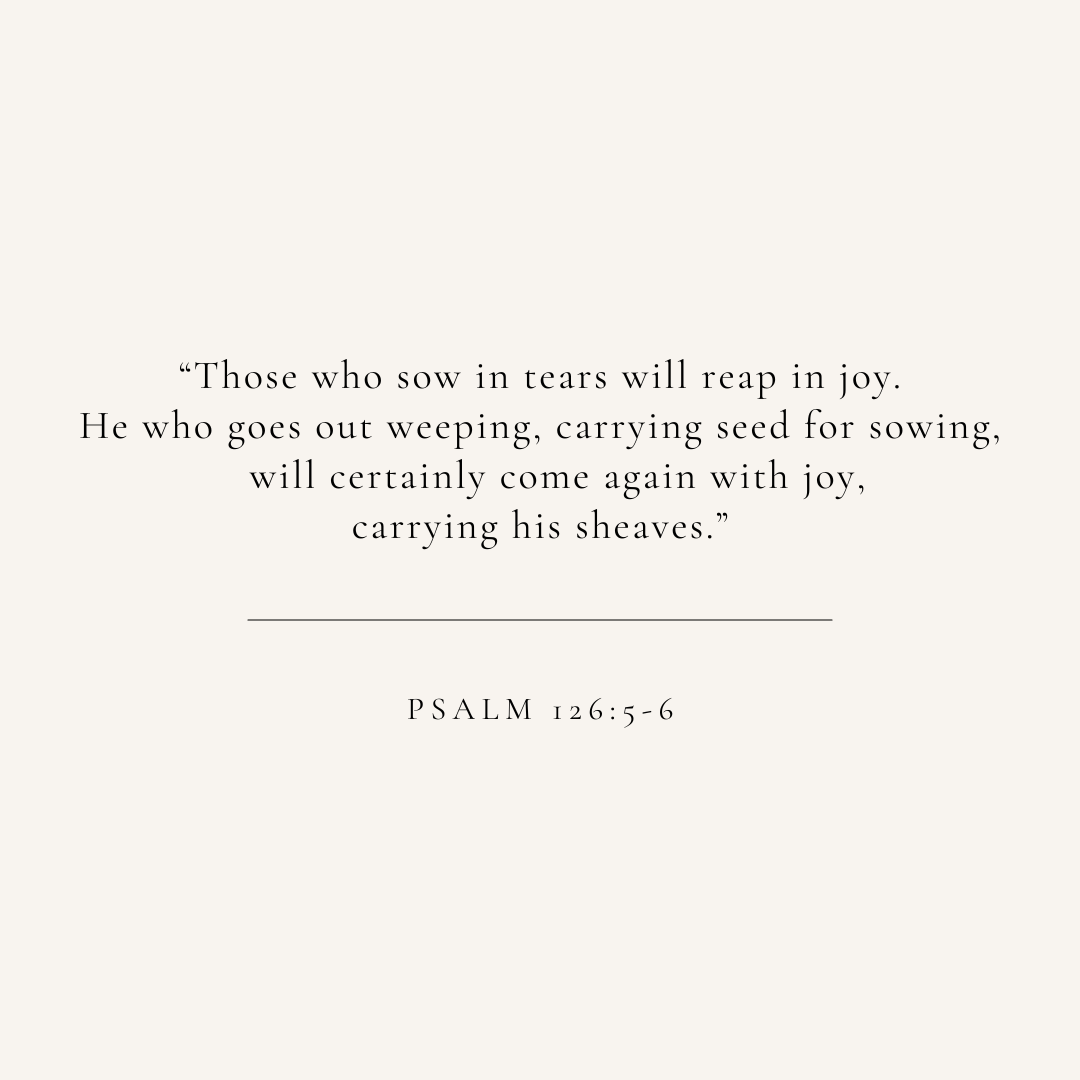
Psalm 126:5-6

All Things Together for Good ·
A Message Has Arrived for You
These are God's promises for you today:
"Keep sowing, even through tears."
"Your faithful planting will bear fruit."
"You will reap in joy."
You have been praying and working hard towards a goal. But you see no results. Nothing seems to change. There is no fruit yet. You wonder if you should keep planting as tears flood your eyes.
Here is what God wants you to know.
The seeds you plant during your hardest season are not wasted. God sees it all: every prayer you prayed through the pain, every act of obedience that cost you much, and every step of faith you took when you wanted to quit. After this season of struggles, He promises a harvest.
Just as spring follows winter, just as harvest follows planting, joy will follow your tears.
So always remember this:
Keep planting, even when it hurts.
This season of tears will come to an end.
You will come back joyfully carrying sheaves.
Deep Dive
The Story Behind The Verse: From Weeping to Joy
In the first book of Samuel, Hannah was married to a man named Elkanah. Her husband loved her, but her womb remained closed. Elkanah's other wife, Peninnah, had children and reminded Hannah of her barrenness. Every year when they went to the temple, Peninnah provoked Hannah until she could not eat.
One year at Shiloh, Hannah went to the temple in deep anguish. She prayed so intensely that her lips moved but no sound came out. Eli the priest thought she was drunk. But Hannah said, "I have been pouring out my soul before the Lord."
Hannah kept faithfully planting seeds of prayer, even through years of tears. She did not stop believing. She did not stop praying. She kept sowing.
And God remembered her. In due time, Hannah conceived and bore a son. She named him Samuel, which means "I have asked for him from the Lord."
Then Hannah praises the Lord. In her song, she declared,
"He raises up the poor out of the dust. He lifts up the needy from the ash heap to make them sit with princes and inherit a throne of glory." (1 Samuel 2:8)
The same God who saw Hannah's faithfulness sees yours. Just as He answered Hannah's prayer, He will answer your prayers according to His good will and timing. He will turn your weeping into singing.
What It Means
"Will reap in joy" (בְּרִנָּה יִקְצֹרוּ / be'rinnah yiqtsoru)
Qatsar means to reap and to gather. Rinnah means joyful shout, exclamation of joy, and songs of celebration. This is overwhelming joy that must be expressed loudly. It is the kind of joy that makes you shout, sing, and dance.
"He who goes out weeping, carrying seed for sowing" (הָלוֹךְ יֵלֵךְ וּבָכֹה נֹשֵׂא מֶשֶׁךְ־הַזָּרַע)
Halokh yelekh repeats the verb "to go" for emphasis. In Hebrew, this repetition intensifies the action: "he certainly goes out." This person moves forward. Bakho means weeping or crying aloud. Meshekh-hazara refers to a bag or pouch of seed. Picture a farmer walking out to the field with tears streaming down his face, yet still carrying the seed bag. He does not wait until circumstances improve. He plants while weeping. This is faith in action.
"Will certainly come again with joy" (בֹּא־יָבוֹא בְרִנָּה / bo-yavo be'rinnah)
Bo-yavo repeats the verb "to come" twice for emphasis. In Hebrew grammar, this doubling communicates guaranteed certainty. It means "Coming, he will surely come." The weeping farmer will return, and when he does, he will be shouting and singing with joy.
"Carrying his sheaves" (נֹשֵׂא אֲלֻמֹּתָיו / nose alumotav)
Alumot means bundles of grain or sheaves—full, heavy bundles gathered together. Nose means carrying. The image is of a person so loaded with harvest that they can barely carry it all.
Claim This Promise
I declare that the words of Psalm 126:5-6 are true in my life.
- • I will keep sowing even through tears.
- • God sees and honors my faithfulness during hard seasons.
- • I will reap sheaves in joy.
Today's Prayer
God,
Thank You for Your promise of a plentiful harvest. Thank You for promising to turn my tears into joy. Sometimes it is hard to keep going. Yet I choose to keep planting. I choose to keep praying and obeying, even when I cannot see the results.
Help me to be like the farmer who still carries and sows his seeds. May I pray to you as Hannah did, continually going before You until You answer my prayers.
When I feel forgotten, remind me that You see me. When my prayers remain unanswered, remind me that You hear my prayers. God, you remember and collect each one of my prayers. Thank you for that.
I trust that my faithful planting will lead to a joyful harvest. I believe that I will return carrying sheaves. Thank You for being my God who keeps His promises.
In Jesus' name I pray, Amen.
Share This Message
Do you know someone who is struggling to keep going?
Share this with them and say, "Keep planting. God sees your faithfulness, and you will reap in joy." Your simple act of sharing could remind them that this season of tears will end with a harvest of joy.